

The UAE has moved from talking about artificial intelligence to running on it. Government entities now report AI utilisation rates above 97%, the country is building one of the largest AI compute clusters on the planet, and the national strategy puts a hard number on the ambition: AED 335 billion in economic value by 2031, equal to roughly 20% of non-oil GDP.
For businesses in Dubai and across the Emirates, that creates a simple reality. AI is no longer a competitive advantage you choose to pursuea; it is fast becoming the baseline your customers, competitors, and regulators expect. The question for 2026 is not whether to adopt AI, but which AI trends in UAE 2026 businesses should prioritize first.
Here are the most important AI trends in UAE 2026 and what each one means for the decisions your business makes in the coming year.
1. The Shift from Generative AI to Agentic AI
The biggest technical change in 2026 is the move from generative AI that writes to agentic AI that does. Instead of a chatbot that drafts an email, businesses are deploying AI agents that can complete multi-step tasks autonomously — booking, reconciling, routing, and resolving without a human in the loop for every action.
For UAE enterprises, this is shortening the time it takes to deploy real capabilities like forecasting, anomaly detection, and workflow optimisation across finance, supply chain, and customer operations. The flip side is a new challenge often called "agent sprawl": as organisations roll out dozens of specialised agents, governing what those agents are allowed to decide becomes a board-level concern. Expect AI governance to become as important as the AI itself in 2026.
What to do about it: Start with one or two well-scoped agentic use cases where the workflow is repetitive and rules-based, and build governance in from day one rather than bolting it on later.
2. World-Class AI Infrastructure Is Landing on UAE Soil
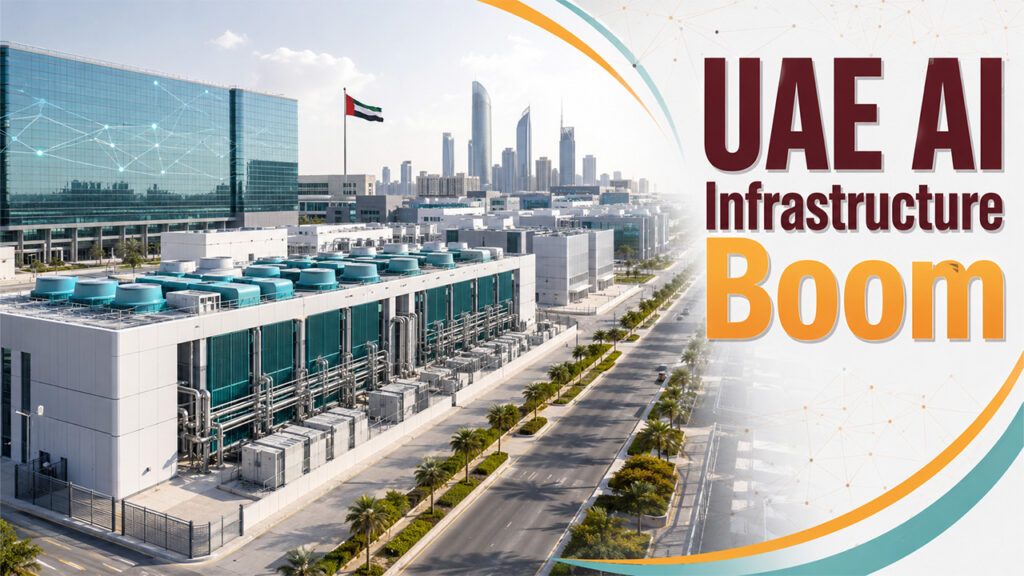
The single most consequential trend for the region is physical: the UAE is building the largest AI infrastructure campus outside the United States. The Stargate UAE cluster in Abu Dhabi — a partnership between G42, OpenAI, Oracle, NVIDIA, Cisco, and SoftBank — is targeting 1 gigawatt of compute, with the first 200MW phase on track to come online in 2026.
This matters for ordinary businesses, not just hyperscalers. Local, high-performance compute means UAE companies can train and run advanced models with lower latency and stronger data residency — a real advantage for organisations handling sensitive customer or government data. Microsoft has separately committed billions to AI-focused cloud regions in the country, deepening the local options for enterprise AI workloads.
Among the most significant AI trends in UAE 2026 is the rapid expansion of local AI infrastructure and compute capacity.
What to do about it: If data residency or latency has been holding back an AI project, 2026 is the year to revisit it. The local infrastructure gap that existed two years ago is closing fast.
3. Custom AI Development Overtakes Off-the-Shelf Tools
Ready-made AI tools are excellent for general tasks, but they rarely fit the specific workflows, languages, and compliance requirements of a UAE business. That gap is driving one of the strongest demand signals in the market: custom AI software development.
The UAE's AI market is projected to grow at a compound annual rate of around 43.9% through 2030, reaching roughly USD 46.3 billion. A large share of that growth is businesses commissioning AI development companies in Dubai and the wider UAE to build solutions designed around their own operations — bespoke recommendation engines, industry-specific predictive models, and automation tuned to local processes.
One of the strongest AI trends in UAE 2026 is the growing preference for custom AI solutions over generic, off-the-shelf tools.
What to do about it: Audit where generic tools are creating friction or compliance risk. Those are usually the strongest candidates for a custom build with a specialised AI development partner.
4. Arabic-First and Bilingual AI Becomes Standard
A model that only performs well in English is a liability in a market where a huge share of customers, contracts, and government interactions happen in Arabic. In 2026, expect serious investment in Arabic natural language processing and genuinely bilingual AI systems, AI chatbots, search, and content tools that handle Arabic and English with equal fluency.
For customer-facing UAE businesses, bilingual AI is quickly shifting from a nice-to-have to an expectation, particularly in government services, banking, retail, and hospitality.
What to do about it: When evaluating any AI solution, test it in Arabic, not just English. Performance parity across both languages should be a procurement requirement.
5. AI Governance, Data Privacy, and Cybersecurity Move to the Front
As AI handles more decisions and more sensitive data, the regulatory and security stakes rise with it. UAE businesses are increasing investment in cybersecurity precisely because cloud, AI, and online customer interactions have widened the attack surface. At the same time, responsible AI — transparency, bias control, and clear accountability for automated decisions — is becoming a reputational and compliance issue, not just an ethical one.
What to do about it: Treat data governance and AI accountability as part of the project scope from the start. Retrofitting compliance after deployment is far more expensive than designing for it.
6. AI Talent Is the Real Bottleneck
The UAE AI Strategy 2031 and rapid private-sector adoption have made AI and machine learning the most in-demand roles in the country — and among the hardest to fill. Strong candidates often field multiple offers within days, and the gap is even wider when cybersecurity and AI skills are required together.
For most businesses, this makes the build-versus-partner decision sharper. Hiring a full in-house AI team in this market is slow and expensive; many UAE companies are choosing to work with established AI development companies to access talent and ship faster.
What to do about it: Decide deliberately which AI capabilities you need to own internally versus partner for. Trying to hire for everything in 2026 is a recipe for delays.
What These Trends Mean for Your Business
Read together, these AI trends in UAE 2026 point in one direction: AI in the UAE is industrializing. The infrastructure, the government backing, the funding, and the talent demand are all aligning, which means the cost of waiting is rising. Businesses that move now — with focused, well-governed, custom AI projects — will compound an advantage over those that treat AI as a someday initiative.
The practical starting point is rarely a giant transformation programme. It is one high-value problem, solved well with the right AI development partner, then scaled.
Frequently Asked Questions
Q1. What are the biggest AI trends in the UAE for 2026?
The leading AI trends in the UAE for 2026 are the shift from generative to agentic AI, major local AI infrastructure such as the Stargate UAE cluster, rising demand for custom AI software development, Arabic-first and bilingual AI, stronger AI governance and cybersecurity, and intense competition for AI talent.
Q2. How fast is the UAE AI market growing?
The UAE AI market is projected to grow at a compound annual growth rate of around 43.9% from 2024 to 2030, reaching an estimated USD 46.3 billion by 2030. The UAE National AI Strategy 2031 targets AED 335 billion in economic value, roughly 20% of non-oil GDP.
Q3. What is agentic AI and why does it matter for UAE businesses?
Agentic AI refers to AI systems that can autonomously complete multi-step tasks rather than just generating text or images. For UAE businesses, it enables automation of complex workflows in finance, supply chain, and customer service, but it also requires strong governance to control what AI agents are allowed to decide.
Q4. Should UAE businesses build AI in-house or hire an AI development company?
Because AI talent is scarce and expensive in the UAE, many businesses choose to work with an established AI development company to access expertise and deploy faster. The right approach depends on which AI capabilities are core to your business and worth owning internally versus partnering for.
Q5. Why is custom AI development in demand in Dubai?
Off-the-shelf AI tools often fail to match the specific workflows, Arabic-language needs, and compliance requirements of UAE businesses. Custom AI development lets companies build solutions designed around their own operations, which is why demand for AI development companies in Dubai is rising sharply in 2026.
%201.png)

%201.png)

%201.png)