

The guide offers a complete deep dive into the on-premises to cloud migration process and offers the benefits, common challenges, and migration strategies for modern businesses.
In the current continuously evolving digital landscape, businesses are under constant pressure to offer more secure, agile, and cost-efficient infrastructure. Businesses are increasingly replacing the traditional on-premises IT infrastructure with cloud-based solutions, as it offers enhanced flexibility, scalability, and innovation.
With the growing adoption of digital solutions, on-premises to cloud migration has become a strategic and essential move for organizations to stay competitive. From small businesses looking to reduce operational costs to large enterprises aiming to improve performance and resilience, on-premises to cloud migration offers significant value to businesses.
Understanding On-Premise and Cloud Infrastructure
For a business, choosing the right IT infrastructure offers various benefits. On-premises infrastructures offer organizations complete ownership over their IT environment, whereas the cloud infrastructure offers improved flexibility, scalability, and access to advanced technology.
What is On-Premise Infrastructure?
On-premises infrastructure refers to an IT ecosystem in which an organization completely owns, hosts, and manages all its hardware, software, servers, networking equipment, and data storage systems within its own physical facilities. Under on-premises IT infrastructure, the organization is fully responsible for installing, maintaining, securing, and upgrading its entire infrastructure.
Key Characteristics of On-Premise Infrastructure
- Complete hardware and software ownership.
- In-house management of maintenance, updates, and troubleshooting.
- High control over configurations, security policies, and compliance.
- Significant upfront capital investment for servers, storage, and software licenses.
What is Cloud Infrastructure?
Cloud infrastructure is an IT environment in which computing resources, which include servers, storage, databases, networking, and software, are hosted by a remote cloud service provider. The solution is delivered over the internet, and it allows businesses to deploy applications, store data, and run workloads without managing any physical infrastructure. Choosing the right managed cloud hosting provider is equally important, as it directly impacts your application's performance, security, scalability, and long-term operational efficiency.
Key Characteristics of Cloud Infrastructure
- On-demand resources can be offered within minutes.
- Organizations can easily scale up or down depending on the needs.
- The cloud provider manages all hardware maintenance and updates.
- Data and applications can be securely accessed from anywhere, using a secure internet connection.
What is On-Premise to Cloud Migration?

On-premises to cloud migration is the process of transferring all the essential applications, databases, servers, workloads, and data of an organization from a locally hosted infrastructure to a cloud-based environment. With on-premises to cloud migration, businesses can efficiently move towards a cloud platform, which offers computing, storage, networking, and software services over the internet.
The main objective of on-premises to cloud migration is to modernize the IT infrastructure of businesses, along with improving operational efficiency, reducing infrastructure costs, and enabling greater scalability.
What is Migrated to the Cloud?
In on-premises to cloud migration, businesses can move a wide range of IT assets, which include:
- Business applications
- Databases
- File storage and documents
- Virtual machines
- Web applications and websites
- Email systems
- Backup and disaster recovery solutions
- Enterprise Resource Planning systems
- Customer Relationship Management platforms
- Development and testing environments
Many organizations also migrate critical business applications such as cloud-based finance platforms, accounting software, and enterprise resource planning (ERP) systems to improve accessibility, collaboration, and financial data security.
Steps of On-Premise to Cloud Migration

Migrating an on-premises IT environment to the cloud infrastructure is a structured process that requires careful planning and execution. A well-defined and careful cloud migration strategy helps the organization in minimizing downtime, reducing risks, protecting business-critical data, and ensuring a seamless transition.
The steps of on-premises to cloud migrations are as follows:
Step 1: Assess Existing IT Infrastructure
Create a complete inventory list of all the pre-existing infrastructures, such as applications, databases, servers, storage, network architecture, and dependencies. It helps in identifying migration complexity and priorities.
Step 2: Define Migration Goals and Business Requirements
Clearly establish why the business is migrating. Setting up business goals helps drive technical decisions.
Step 3: Select the Right Cloud Model
Selecting the right cloud model helps businesses achieve efficient performance. Businesses can choose between various models, such as public cloud, private cloud, hybrid cloud, and multi-cloud. Selecting the right model generally depends on the workload requirement, compliance, budget, and business strategy of the business.
Step 4: Create a Migration Roadmap
Develop a detailed migration plan, which can include a proper timeline, resource allocation, risk assessment, testing strategy, rollback procedures, and success metrics.
Step 5: Ensure Secure Data Migration
Businesses should transfer data using secure and encrypted methods. The user also needs to verify data integrity after migration and before switching production workloads.
Step 6: Test Thoroughly
Businesses should test migrated data thoroughly. The testing process should include performance testing, security testing, user acceptance testing, application functionality, and integration validation.
Step 7: Optimize Cloud Resources
After deployment, businesses should continuously optimize various components, such as computing resources, storage utilization, network performance, security policies, and cost management.
Why Are Businesses Moving to the Cloud?
Organizations across multiple industries are continuously adopting cloud technologies, mainly because it offers various key advantages compared to traditional on-premises infrastructure. Some of the key advantages of moving to the cloud infrastructure are as follows:
Reduced Infrastructure Cost
For businesses, maintaining physical servers often requires significant investment, especially in hardware, maintenance, software licenses, and IT personnel. Migrating to a cloud platform helps businesses eliminate almost all of this capital expenditure. In cloud infrastructure, businesses often pay for the resources they use, reducing unnecessary expenses.
Enhanced Scalability
One of the major limitations of on-premises infrastructure is scalability. In on-premises IT infrastructure, expanding storage or computing capacity often requires purchasing and installing additional hardware. The cloud services allow the organization to efficiently scale resources up or down instantly, depending on demand.
Enhanced Security
Cloud providers often invest a huge amount in enhancing cybersecurity, compliance, and infrastructure protection. The leading cloud infrastructure provider offers key features, such as:
- Data encryption
- Identity and access management
- Continuous monitoring
- Threat detection
- Automated backups
- Disaster recovery
Improved Business Agility
The cloud infrastructure helps businesses in enabling faster application deployment, automating workflows, and introducing new services with minimal delays. The migration ensures that the deployment teams can provision environments within minutes, instead of waiting weeks for hardware procurement.
Common Challenges in On-Premise to Cloud Migration
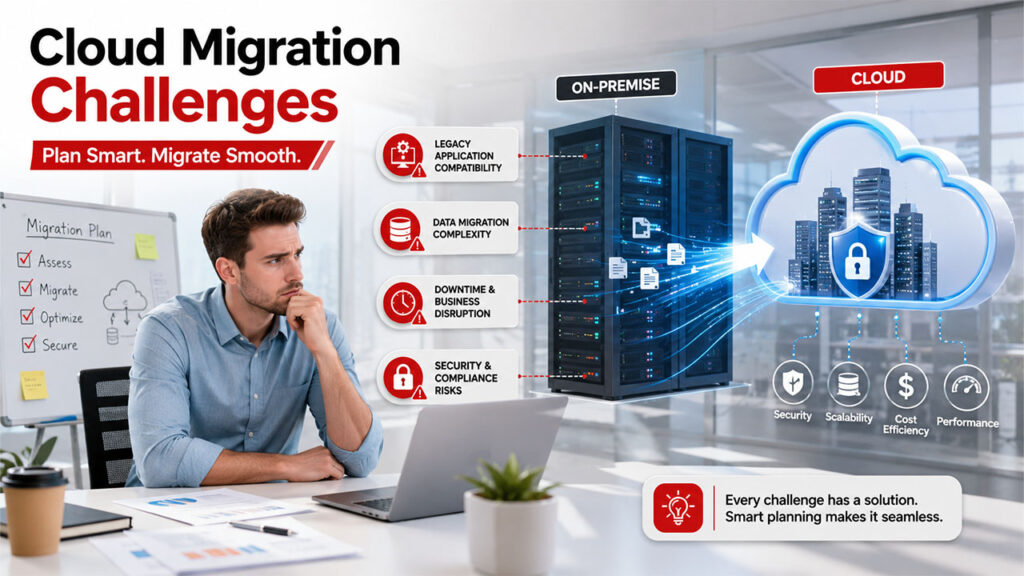
On-premises to cloud migration offers various key benefits to businesses, but the process also includes key challenges. Cloud migration involves moving various critical applications, data, and business processes to a completely new environment. The process includes careful planning and execution essential.
Some of the key challenges in on-premises to cloud migration are as follows:
Legacy Application Capability
Various organizations across the globe rely heavily on legacy applications, which were primarily designed to run on traditional on-premises infrastructure. Such applications may not be compatible with modern cloud environments, mainly due to outdated architecture, unsupported software, or hardware dependencies.
Data Migration Complexity
Migrating large volumes of business-critical data is one of the most complex and challenging aspects of cloud migration. Some of the key data migration complexities include:
- Data corruption
- Data loss
- Duplicate records
- Incomplete transfers
- Extended migration times
- Bandwidth limitations
Downtime and Business Disruption
Migrating business applications and databases can lead to disruption in operations if not managed carefully. This can be reduced by following a phased migration approach, which often helps in reducing operational risks.
Security and Compliance Concerns
Protecting sensitive business data, especially during and after migration, should be the most important priority of businesses. Some of the key security concerns include:
- Unauthorized data access
- Misconfigured cloud resources
- Weak identity and access controls
- Data breaches during transfer
- Inadequate encryption
Conclusion
On premise to cloud migration is not just a technological upgrade, but it is considered a strategic initiative, which enables businesses to modernize their entire IT infrastructure. Cloud migration also helps businesses improve their operational efficiency while remaining competitive in an increasingly digital landscape. The migration moves key business applications, databases, and workloads from a local IT infrastructure to a cloud environment that can be accessed via the internet.
As businesses across the globe are continuously embracing digital transformation, cloud migration has become one of the key drivers in enhancing the agility, resilience, and long-term growth of organizations. A strategic approach for on-premises to cloud migration helps businesses achieve greater efficiency, along with improved customer experience and building a future-ready infrastructure.
Read also: Lifetime Cloud Storage: Is a One-Time Payment Plan Worth It
FAQs About On-Premise to Cloud Migration
Q. What are the different types of cloud migration strategies?
There are various types of cloud migration strategies, among which Rehosting, Replatforming, Refactoring, Repurchasing, Retiring, and retaining are among the most popular types of cloud migration strategies.
Q. How long does it take for on-premises to cloud migration?
The on-premises to cloud migration timeline generally depends on various factors, such as application complexity, infrastructure size, data volume, and migration strategy. Small migration might take a few weeks, while enterprise-level migration can take several months.
Q. Is cloud migration secure?
Yes, cloud migration is highly secure, especially when an organization implements key security measures, such as encryption, identity and access management (IAM), multi-factor authentication (MFA), among other measures.
Q. Can I migrate legacy applications to the cloud?
Yes, you can migrate legacy applications to the cloud. It can be migrated using various strategies, such as rehosting, replatforming, or refactoring.
%201.png)

%201.png)

%201.png)