
Selecting an email marketing solution can transform how successfully a business connects with its subscribers, and two names always come up in the conversation: Constant Contact and Mailchimp. Both solutions enable you to handle contact lists, design campaigns, and automate follow-ups. However, they differ in terms of features, pricing, and the type of user they best suit. In this Constant Contact vs Mailchimp comparison, let us break down what each platform entails so you can compare the two tools and find out which one is right for your marketing objectives. Irrespective of whether you are a beginner sending your first newsletter or an evolving business that requires sophisticated segmentation, this difference between the two providers is extremely important. Below that, let us explore the basics of every platform, compare their pricing, and where each one is better than the other.
Constant Contact Vs Mailchimp: The Overview
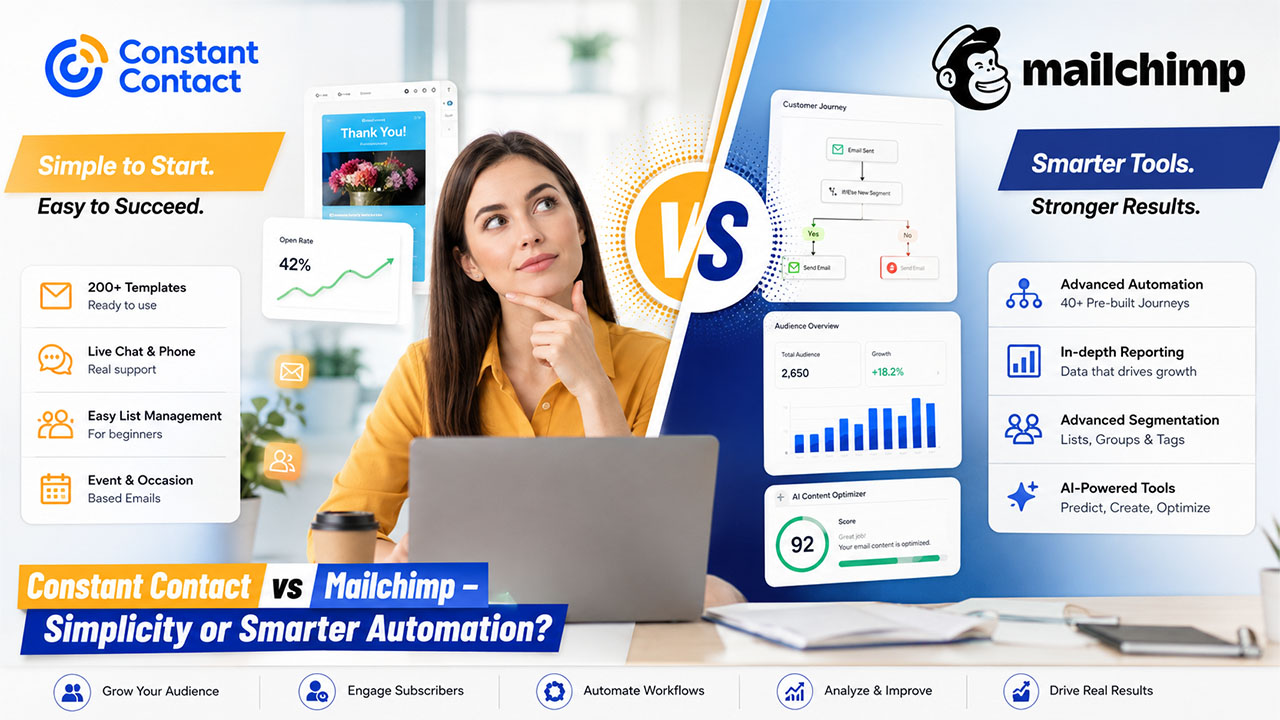
Constant Contact refers to an email marketing solution purpose-built for beginners and small businesses. It provides a substantial number of occasion-specific, ready-to-send templates, simple list management, and live and phone chat support, making it a possible choice for teams without having a dedicated marketing staff.
Mailchimp refers to a marketing and email marketing automation solution focused on businesses that require in-depth reporting, audience segmentation, and AI-driven content tools. It also provides a free plan for smaller lists, along with premium plans that unlock testing and automation features.
- Constant Contact: beginner-friendly, template-heavy, and strong live chat support.
- Mailchimp: Detailed reporting, automation-heavy, and a wider AI toolset.
Pricing: Constant Contact vs Mailchimp

Pricing is generally the defining characteristic between the two platforms, and the structures are not identical:
- Mailchimp provides a free plan for close to 500 contacts and 1,000 monthly sends, and a pay-as-you-go option for occasional senders. Premium plans then evolve with the size of the list. It is approximately $45/month for 2,500 contacts on the Essentials tier.
- Constant Contact entirely skips the free plan, offering just a 30-day free trial. Its Lite plan begins around $12/month for close to 500 contacts and rises from there, with no alternative of pay-as-you-go pricing.
- If you go for a higher contact volume, the gap further reduces. The Standard and Premium plans of Constant Contact sometimes exist between the Standard and Premium pricing of Mailchimp, so the cost-effective option depends on the precise tier and feature set you require.
- Both require additional charges for SMS: Mailchimp offers a bundle of 1,000 SMS credits at $20/month, while Constant Contact offers SMS at $10/month for 500 messages, which can be more cost-effective for compact texting requirements.
Businesses looking for an end-to-end digital marketing solution can go for a robust CRM with options to integrate either of these tools. If you want to know how CRM improves your digital marketing efforts, check out our detailed guide.
Features and Automation
Where you will see a clear difference between Constant Contact and Mailchimp is testing options and automation depth:
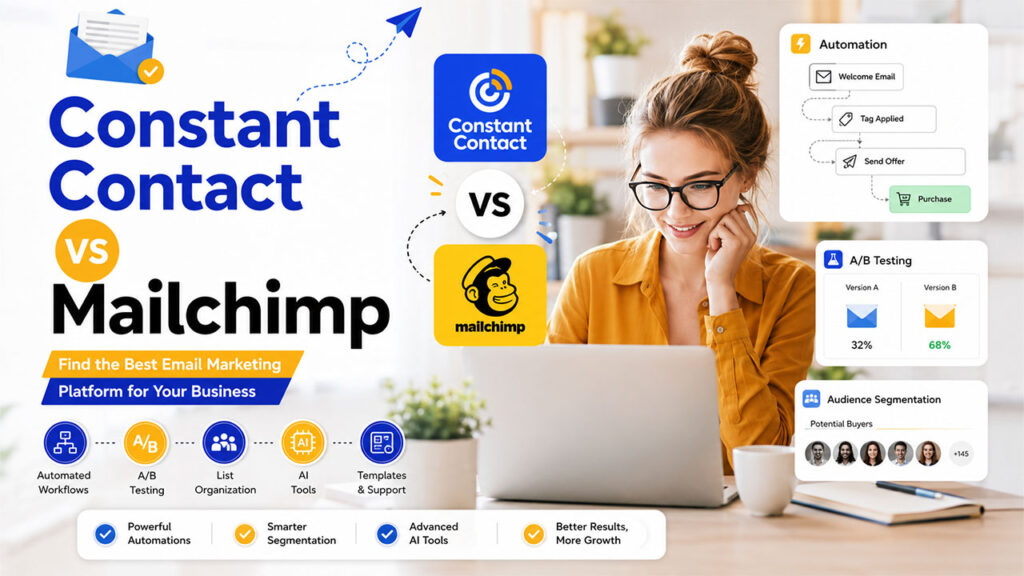
- Mailchimp offers close to more than 40 pre-built automated journeys, multivariate A/B testing across content, subject lines, send name, and send time, as well as a visual customer journey builder.
- Constant Contact encompasses the essentials quite well: birthday, welcome, and anniversary automations. Furthermore, it also includes abandoned cart emails for e-commerce. However, its A/B testing is restricted to subject lines only.
- Mailchimp also further leans into AI, with a Creative Assistant for predictive audience segmentation and brand-based designs, while the AI content generator of Constant Contact mainly focuses only on creating copy in a few selective tones.
- List organization is important as well. Mailchimp includes an additional Group layer on top of segments, lists, and tags, providing finer targeting than the simple segment-and-tag structure of Constant Contact. However, it also includes a steeper learning curve.
| Feature | Constant Contact | Mailchimp |
| Automated workflows | Anniversary, Welcome, Birthday, and Abandoned Cart | More than 40 custom triggers, pre-built journeys |
| A/B testing | Subject line only | Content, subject line, send name, and send time |
| List organization | Tags and Segments | Segments, Lists, Groups, and Tags |
| AI Tools | BrandKit, AI Content Generator | Predictive Segmentation, Creative Assistant |
| Templates | More than 200, specific to an occasion | Approximately 130, with dynamic blocks of content |
| Support | Phone, Live Chat, and Onboarding Calls | Weekday Chat, Help Center, and 24/7 email |
Teams that direct leads already through a customer relationship management tool can benefit from assessing how automating email marketing campaigns with a CRM can complement whichever tool they choose, since synchronized customer information tends to improve accuracy of segmentation.
Reporting, Templates, and Support
- Constant Contact provides more than 200 occasion-specific and detailed templates, which helps users who require a polished email without heavy work in design.
- Mailchimp ensures lesser templates. However, its newer builder enables dynamic content blocks and in-line editing on premium plans.
- On reporting, Constant Contact ensures that things remain simple with organized bar-chart summaries of clicks, opens, and conversations. On the other hand, Mailchimp goes deep with click maps, comparative reports, and a Content Optimizer on its standard plan and above.
- Deliverability is comparatively close between the two: both reduce spam and bounce complaints and ensure effective sending practices. However, neither of them provides a complete deliverability dashboard.
- For support, Constant Contact is a better option for phone support and live chat on most plans and also proactive onboarding calls. On the other hand, Mailchimp depends on a detailed Help Center, 24/7 email support for premium users, and weekday live chat, reserving phone support assistance for its top plan.
Conclusion
There's no universal right option for businesses, as the Constant Contact vs Mailchimp comparison showcases. The choice hinges on your budget as well as your priorities. Choose Constant Contact if you need ready-made or simple templates, and responsive and real-time assistance. Choose Mailchimp if you require in-depth automation, more comprehensive reporting, and AI-powered tools as your campaigns and list size grow. Testing the free option or using the trial period of both platforms before choosing a premium plan is a possible way to find out which feature set and interface precisely align with your workflow.
FAQs About Constant Contact vs Mailchimp
Q1. Is Mailchimp more cost-effective than Constant Contact?
A- For businesses with smaller lists, Mailchimp proves to be a better option because of its lower entry pricing and free plan, which makes it more cost-effective to begin with. However, as the volume of contacts increases, the gap reduces, and the costs depend on the pricing plan.
Q2. Which platform is a reliable option for beginners?
A- Constant Contact proves to be simpler for first-time users, courtesy of its hands-on phone support and ready-made templates.
Q3. Do both platforms provide SMS marketing?
A- Yes. Both Constant Contact and Mailchimp provide SMS as an add-on. However, they require separate pricing.
Q4. Can I move my contacts from Constant Contact to Mailchimp, or vice versa?
A- Yes. Both platforms ensure an easy list import through direct account migration tools or CSV, so moving between the providers does not mean that you must begin your contact list from zero.
Q5. Which platform proves to be a better option for e-commerce automation such as abandoned-cart emails?
A- Both provide support for abandoned cart automation. However, Mailchimp ensures pre-built e-commerce journeys and in-depth product suggestion features. On the other hand, Constant Contact makes sure that e-commerce automations are more standard and quicker to set up.
%201.png)

%201.png)

%201.png)