
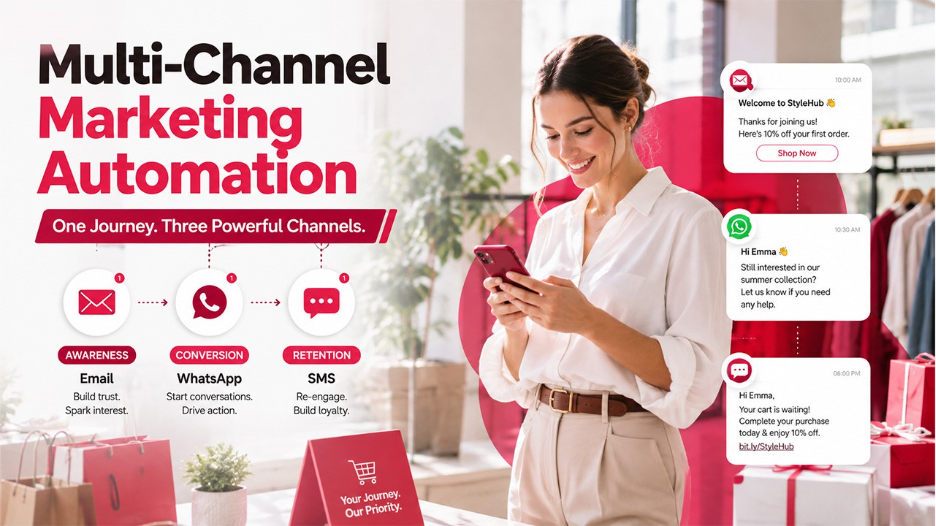

The multichannel marketing automation market is growing at 26.1% annually — a clear sign that sticking to a single channel isn’t just outdated, it’s a growth ceiling (Zoho).
And the numbers back it up: Optimove found multi-channel campaigns are 37% more effective than single-channel, with a 14% response rate versus 10.2%. Meanwhile, brands using three or more channels see a 287% higher purchase rate, and those orchestrating five or more coordinated channels push that lift to 412% (Improvado). It’s not subtle — adding more relevant touchpoints makes a massive difference.
That said, slapping every channel onto every customer without a plan creates noise, not value. The real win comes from layering channels by their natural strengths inside a clear automation flow.
In this article, we’ll walk you through a practical three-layer architecture — Awareness (email), Conversion (WhatsApp), and Retention (SMS) — with the trigger logic, handoff rules, and real-world examples that keep your stack from turning into a tangled mess.
The Three-Layer Automation Architecture at a Glance
Instead of treating email, WhatsApp, and SMS as interchangeable broadcast pipes, think of them as distinct roles in a customer journey. Email handles broad, low-cost awareness; WhatsApp powers real-time, high-touch conversation that drives conversion; and SMS delivers the urgent, bite-sized nudges that boost retention.
Each layer plays its part, and automation hands the baton between them based on behavior — not random timers.
This isn’t a wild theory. EmailAudience maps the email marketing funnel to four core stages: Awareness, Consideration, Conversion, and Retention. Our architecture leans into that model, anchoring Awareness to email, Conversion to WhatsApp, and Retention to SMS, while blending the Consideration stage across channels as needed.
Automation is what makes it hum — it can boost sales productivity by 14.5% and cut marketing overhead by 12.2% (LeadsBridge). And when you fold non-email channels into lifecycle campaigns, the results get dramatic.
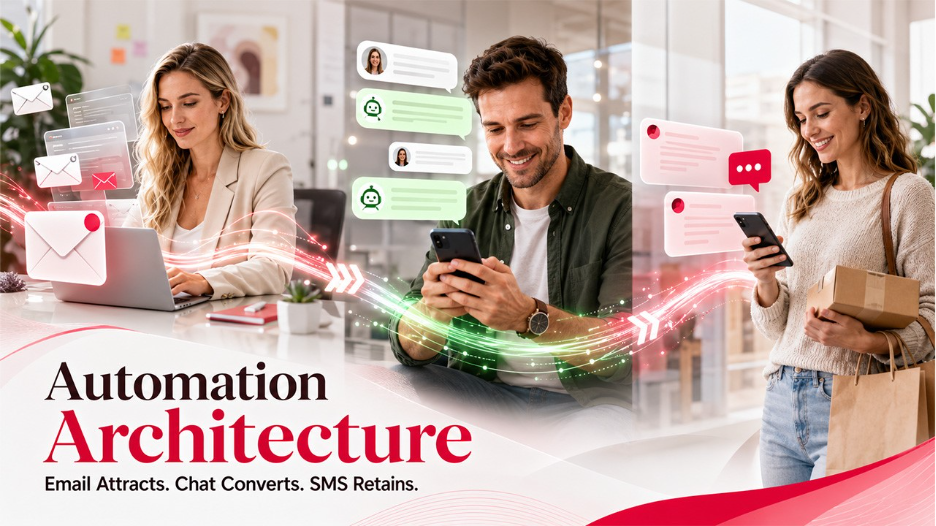
Layer 1: Awareness — Email’s Role at the Top of the Funnel
Email still dominates the top of the funnel for good reason: it’s astonishingly cost-effective and scalable. The ROI for email marketing typically lands between 10:1 and 36:1, with top-performing programs exceeding 50:1 (HubSpot).
And when you move from batch-and-blast to automated, the gap widens. Automated emails generate 320% more revenue than generic ones, with 70% higher open rates; trigger-based emails alone hit a 45.38% open rate (Stripo).
In the awareness layer, triggers fire when someone joins your list, downloads a lead magnet, consumes educational content, or engages with a blog digest. The content is long-form, value-packed, and infrequent — designed to build trust and move a subscriber from “who are you?” to “tell me more.” At this stage, you’re warming up the relationship, not pushing for a sale.
But how do you know when a cold lead is ready for the next step? Engagement signals. A click on a product-link, a visit to your pricing page, or repeated consumption of a specific resource all suggest the prospect is sliding into Consideration.
That’s your cue to hand off to the conversion layer — ideally through a WhatsApp invitation that turns passive reading into an active conversation.
Layer 2: Conversion — WhatsApp’s Conversational Power
If email is your broadsword, WhatsApp is your scalpel. The open rates are in a different universe: 95–98% compared to email’s 42.35%, and the WhatsApp Business API consistently sees a 99% open rate (Chatfuel). People simply live inside messaging apps — 67% now expect to communicate with businesses there.
Where WhatsApp really shines is in the messy middle of conversion. Businesses can recover up to 60% of abandoned carts with automated WhatsApp notifications, and a single campaign from Mercedes-Benz Turkey achieved a 63% lead-to-conversion rate. Companies that use WhatsApp Business report 225% faster customer service and a 27% sales increase.
Conversion triggers in this layer include abandoned carts, browsing abandonment, demo requests, or any high-intent behavior that signals a buyer is on the fence.
For example, when a prospect clicks “Book a Demo” inside an email, the system can fire a personalized WhatsApp message from a sales rep or AI agent within minutes, keeping the momentum alive.
The email layer simply passes a “conversion-ready” segment over, so the same customer never receives redundant messages from both sides.
Layer 3: Retention — SMS for Timely Re-engagement
SMS doesn’t ask for attention — it commands it. The channel boasts a 98% open rate, and click-through rates average nearly double email’s. That immediacy makes SMS the ultimate retention weapon.
Marketers feel the difference: 58% see a noticeable impact on re-engagement and retention after adopting SMS, and consumers say an SMS instantly reminded them of a brand they’d forgotten (Plivo).
The purchasing behavior backs it up — 72% of people have bought after receiving a text from a brand, and 65% purchased earlier than planned because of a promotional SMS (Klaviyo). Last year, 86% made two or more purchases from SMS messages.
The synergy with email is striking. And consumers are more likely to buy when they see the same promotion across email and SMS — not as annoying duplication, but as coordinated reinforcement (Attentive).
From a lifecycle economics perspective, the retention payoff is enormous. Raising customer retention by just 5% can boost profits by 25–95%, and acquiring a new customer costs 5–25 times more than keeping an existing one (Harvard Business Review).
So SMS retention flows — post-purchase follow-ups, replenishment reminders, win-back sequences, and time-sensitive exclusive offers — pay for themselves quickly.
The Decision Tree: When to Hand Off Between Channels
To avoid the dreaded multi-channel mess, you need a straightforward decision tree that uses real behavior, not guesswork. Here’s a simple version:
Entry point: Email awareness flow:
→ If a subscriber shows high engagement (clicks a CTA, visits a pricing page), hand off to the WhatsApp conversion flow.
During WhatsApp conversion:
→ If no conversion happens after a set number of interactions, escalate to an SMS with a limited-time offer or urgency.
Post-purchase or lapsed customer:
→ If no purchase in 30 or 60 days, trigger a retention SMS sequence.
Reactivation test:
→ If a customer is active but ignoring emails, try a WhatsApp re-engagement nudge to break the pattern.
The handoff rules live on two pillars: real-time behavioral triggers (clicks, page visits, form fills) and time-based inactivity windows. No arbitrary date stamps.
And since consumers are more likely to buy when they see coordinated email-and-SMS promotions, synchronized messaging across layers is essential — not duplicated blasts.
The seamlessness demands a unified customer profile that shares engagement data across channels, so nobody gets a “We miss you” email and an “Exclusive new offer” WhatsApp in the same hour.
Real-World Workflow Examples
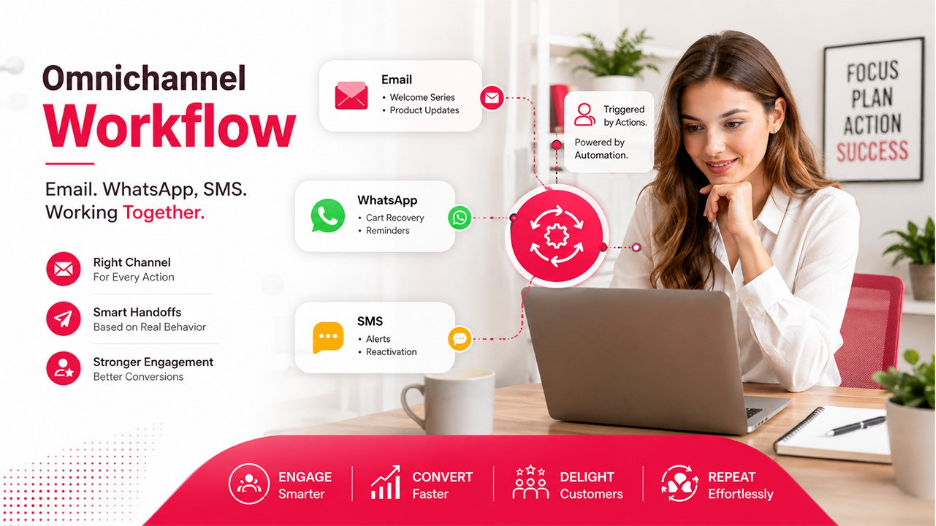
Let’s make it concrete with two examples.
DTC brand: A new subscriber enters a welcome email series. If they click “Shop now” but don’t complete a purchase, the system triggers a WhatsApp cart recovery message with a discount code. Still no purchase after 24 hours? An SMS reminder lands, emphasizing the code’s expiry. Email, WhatsApp, SMS — each does its job with no overlap.
B2B SaaS: A lead receives an email nurture sequence and registers for a webinar. WhatsApp fires a confirmation and reminder. After the webinar, an email delivers the recording. If the lead starts a trial but doesn’t convert, a WhatsApp sales follow-up picks up the conversation. Thirty days of inactivity later, an SMS reactivation prompt lands. The handoffs are based on real actions, not hopes.
Tools to Power Your Multi-Channel Automation
Making this work without a Frankenstein stack requires tools that talk to each other — or a unified platform that spans channels. For the WhatsApp layer specifically, a platform like Wati — built on the official WhatsApp API — can act as your conversational engine.
Real-world outcomes back it up: Bowaba delivered 11x ROAS with Click-to-WhatsApp Ads, and Zellbury hit an 87% customer satisfaction rate on support, all via WhatsApp.
The built-in no-code AI chatbot builder, Astra, creates AI agents for you that can also handle up to 60% of customer queries automatically, slashing support tickets.
Wati is trusted by 16,000+ businesses, holds Premium Partner status with Meta and Google, and is backed by Tiger Global, Sequoia, DST Global, and Shopify.
While Wati excels on the WhatsApp side — and offers built-in regional SMS fallback mechanism for compliance — the best practice is still to pair it with an email and SMS provider that integrates cleanly, so you keep that single customer view without data silos.
Caveats & Counterpoints
Multi-channel automation isn’t a plug-and-play silver bullet. Poor data sync can duplicate messages or send mixed signals, and messaging-app fatigue is real — overuse of WhatsApp or SMS will drive opt-outs fast. Consent and frequency controls become non-negotiable.
Remember, email remains the backbone for many businesses. WhatsApp and SMS are complements, not replacements. The architecture works best when you play each channel’s strength — not when you turn everything into a broadcast clone.
Conclusion
The three-layer architecture separates channels by natural role — email for awareness, WhatsApp for conversion, SMS for retention — with clear handoff triggers that avoid duplication.
If you’ve already mastered email automation, you can layer in WhatsApp and SMS without creating a tangled mess, driving higher engagement and revenue across the entire customer journey. No guesswork, just smart orchestration.
%201.png)

%201.png)

%201.png)