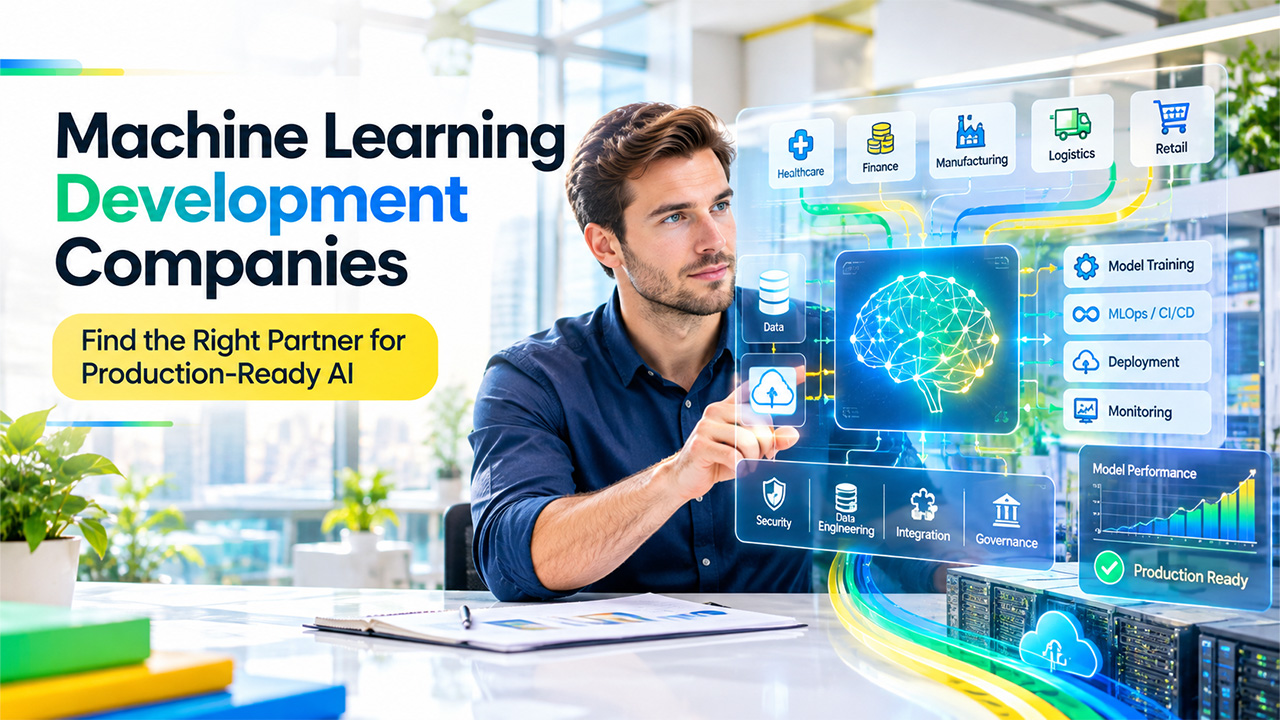

Machine learning development companies build, train, deploy, and maintain production ML systems. This includes custom models, the data pipelines feeding them, the MLOps, and the governance layer.
US enterprises invest in building AI chatbots, but the real investment comes in integrating these intelligent systems into operational functions. And this is where most of the enterprises struggle.
Because it's not just about choosing the right AI model, enterprises need to navigate different implementation challenges like lack of data accuracy, infrastructure bottlenecks, and legacy systems. And this is why enterprises need a machine learning development services provider to implement their AI projects.
This guide covers top machine learning development companies in the USA delivery range, what each one is actually built for, the services worth paying for, and the questions that separate a vendor who ships to production from one who ships a demo.
The State of Machine Learning Development in the US
US demand has moved past experimentation and into consolidation. Enterprises are already investing in AI model training and integrations. However, most of these enterprises are struggling to convert these investments into ROI.
IF you want to define the market, it can be best done by focusing on three critical shifts.
1. Rise of Generative AI
Generative AI was the first wave of AI pilot budgets that got approved by enterprises. While this was a new innovation, many enterprises jumped the gun and invested massive amounts, leading to massive budgets. This led to a dearth of further investments in AI pilots because of overspending on the initial investments of generative AI projects.
2. From Staff Augmentation to Outcome-Based Model
More and more enterprises are now shifting to a more outcome-based model. What this means is that the conventional approach of staff augmentation is transforming into a model that promises results.
3. Security and Compliance
Every ML development company is now evaluated not only on their technical prowess but also on what type of security their solution offers. This eliminated vendors without SOC 2, ISO 27001, or HIPAA posture.
Methodology: How We Evaluated and Shortlisted Companies
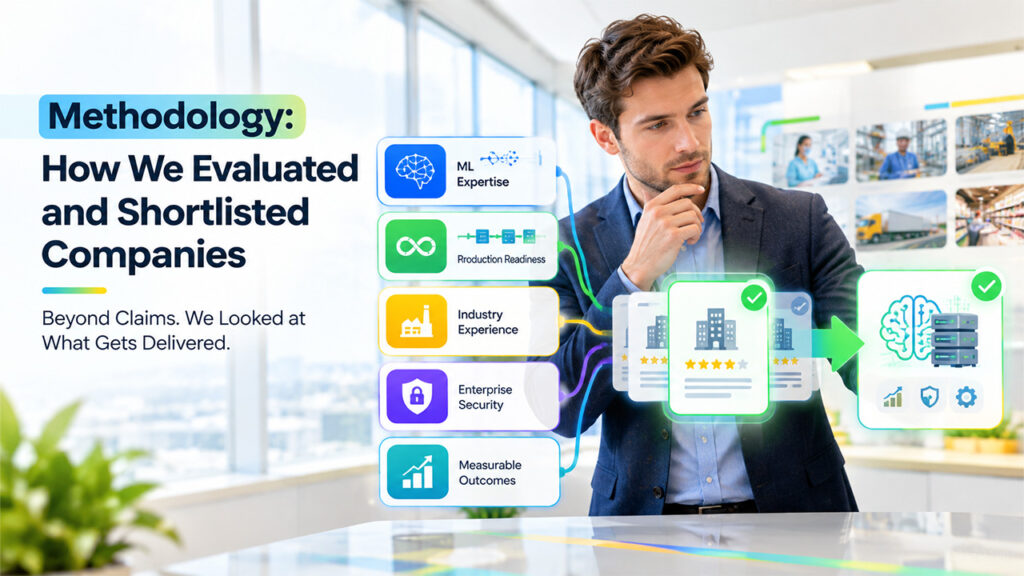
Every company here was assessed against the same five criteria, weighted toward production delivery rather than marketing claims.
- Core ML skills, demonstrated in shipped work: in-depth supervised learning, computer vision, NLP, recommendation systems, and forecasting.
- Whether the company builds CI/CD pipelines for models, provides drift monitoring, model retraining triggers, and rollback control, or leaves the client with a model file.
- Experience in the industry and track record of delivering in regulated and operationally complex sectors: fintech, insurance, healthcare, manufacturing, logistics, retail.
- Enterprise security posture, ISO 27001, SOC 2 Type II, HIPAA, GDPR, and documented data handling for model training on proprietary data.
- Named outcomes that relate to a business metric vs. accuracy scores alone.
That last criterion is where most shortlists collapse. Accenture's July 2026 Pulse of Change research found only 23 % of organizations report widespread, sustained business value from AI, down from 32 % earlier in the same year.
Value realization is getting harder, not easier, which makes a partner's track record on measured outcomes the single most useful filter you have.
Top ML Development Companies in the US
Each profile below covers the firm's founding year, base of operations, scale, ML capabilities, and the type of engagement it is built for.
1. MultiQoS
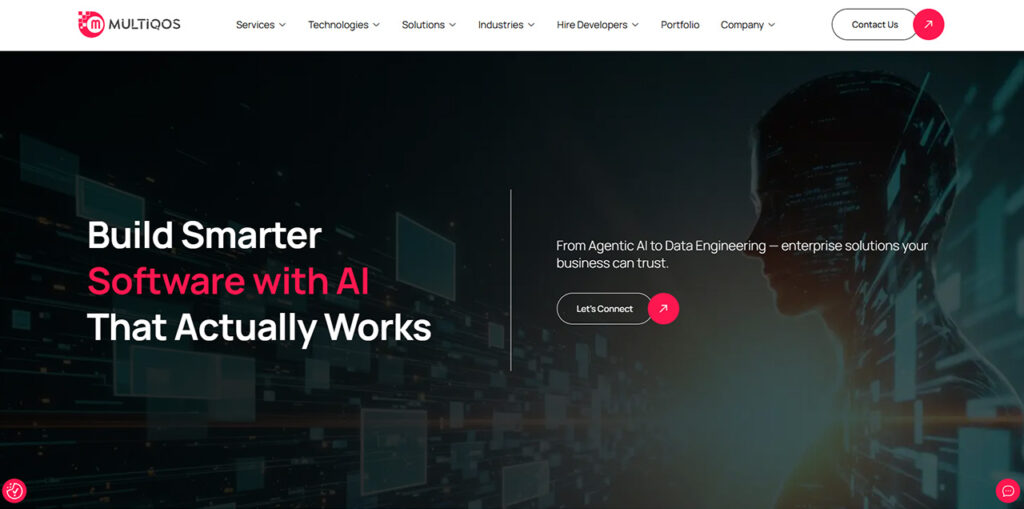
With over 14 years of experience, MultiQoS has delivered over 700+ projects to over 370+ clients from over 40+ industries such as manufacturing, fintech, supply chain, retail, healthcare, and real estate. It's almost all AI/ML work today: custom model development, computer vision development, NLP, generative AI, and the data engineering behind it.
It's built with Python, TensorFlow, PyTorch, and LangChain on Azure, AWS, and GCP.
ML Development Capabilities
- Custom ML and Neural Network Development: Creates specific business-related models and Neural Networks.
- Predictive Analytics and Fraud Detection: Provides demand forecasting, risk-scoring, and fraud detection.
- Computer Vision and NLP: Works on computer vision and natural language processing systems.
Recommendation Engines and Process Automation: Develops recommendation systems and process automation with ML for common tasks.MLOps and MLaaS: Implements production pipelines with Docker, Kubeflow, AWS, Azure, or GCP using MLflow.
Why Choose MultiQoS?
Most businesses can find a vendor to build a working model. Projects stall later, when that model has to run inside ERP, CRM, or warehouse systems that were never designed to use AI output.
- MultiQoS maps the deployment environment, integration points,s and data flows during the proof of concept (POC) stage of the implementation process, avoiding the need to rebuild pipelines when data volume and user numbers increase.
- If the data in a model is not reliable, then neither is the model. By incorporating the ingestion layer, cleansing layer, and pipeline layer, MultiQoS prevents incomplete or fragmented data from affecting model accuracy in production.
- Cross-Industry Use Case Depth: If your industry is manufacturing, fintech, supply chain, retail, healthcare, or real estate, you're starting your project from a proven framework of Use Cases, such as demand forecasting, defect detection, document processing, fraud detection, and more.
- Teams are defined by building on Azure, AWS, or GCP to match your existing infrastructure, without having to change platforms to adopt ML.
- Custom models, computer vision, NLP, and generative AI with LangChain. The fewer times resources are passed from vendor to vendor, the shorter the cycle time.
Who Should Partner with MultiQoS?
MultiQoS is an ideal solution for mid-market and enterprise teams looking for a single accountable party to handle the model, the pipeline, and integration into existing systems.
2. ScienceSoft
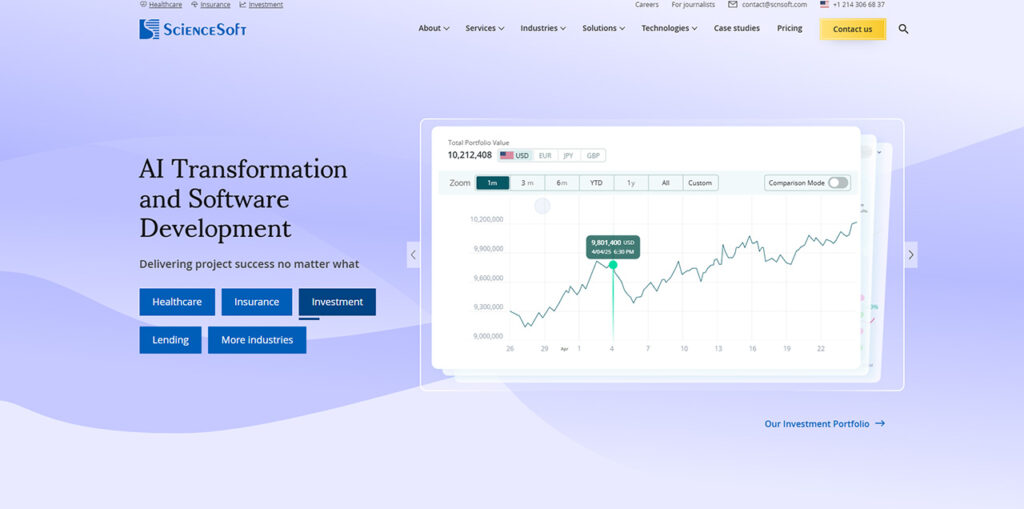
Based in McKinney, Texas, ScienceSoft was established in 1989. It is the oldest company in this list, and there are 750+ IT professionals. It holds ISO 9001, ISO 27001, and ISO 13485:2016 certifications.
If you write software for medical devices, then you'd better care about ISO 13485. It's embedded in a larger data services organization that includes data science, analytics consulting, image analysis, and big data engineering.
Who Should Partner with ScienceSoft?
ScienceSoft is ideal for the healthcare and finance sectors, where documentation, audit trail, and certification are mandatory procurement requirements.
3. InData Labs
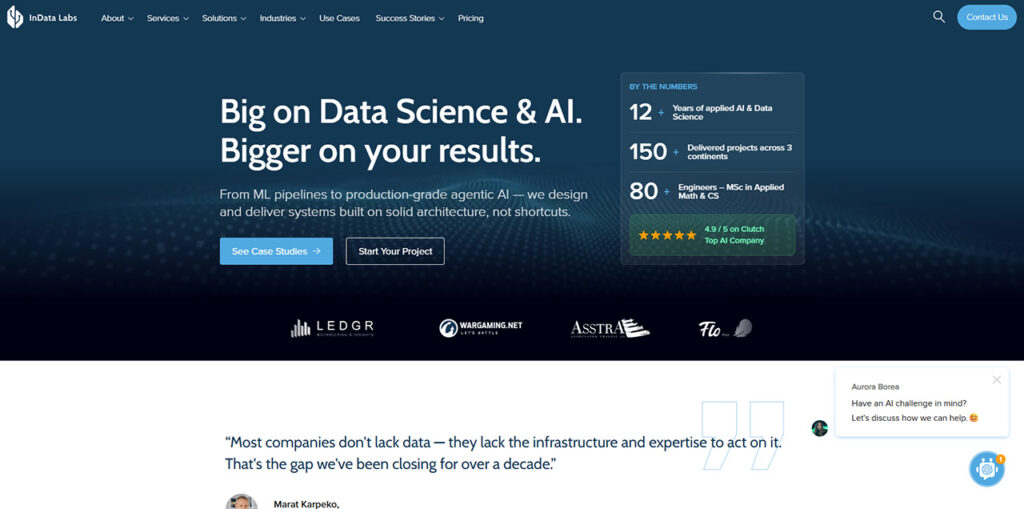
InData Labs has been established since 2014. Based in Cyprus, it also has an office in Miami, Florida, USA, and is a data science and AI specialist. It has 80+ specialists, has delivered 150+ projects, and is a partner of AWS and Databricks.
It has a product-company heavy bias with Flo, Wargaming, GSMA, and Captiv8. Service areas encompass machine learning, computer vision, Natural Language Processing (NLP), Generative AI with RAG and Agents, and big data analytics.
Who Should Partner with InData Labs?
For digital products with lots of data, where the model is the primary part of the product, InData Labs is the best option.
4. Appinventiv
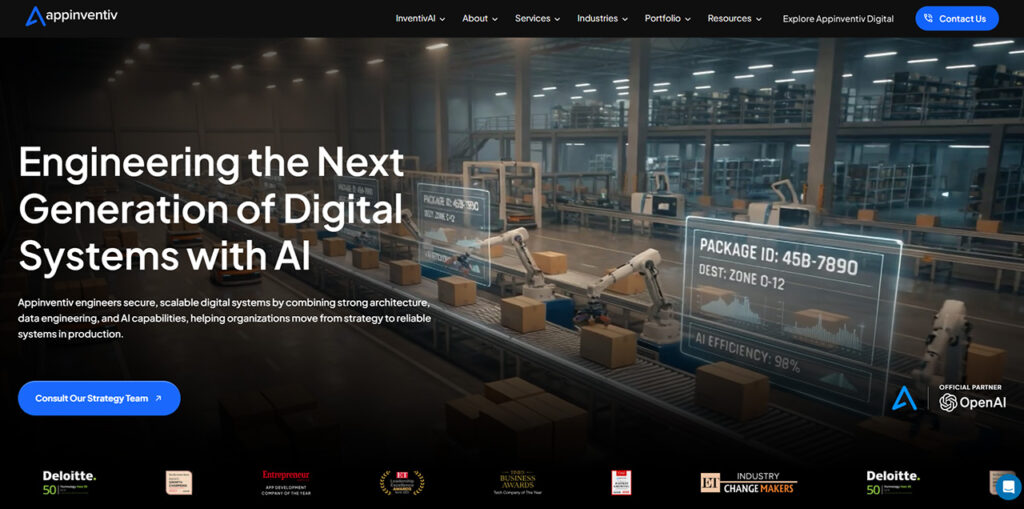
Appinventiv was established in 2015. Its head office is located in Noida, India, where it currently employs approximately 1,700 people across the world, with an office in Manhattan, New York, USA. It has delivered 3,000+ digital products across 35+ industries. It has deployed 100+ AI and generative AI solutions through its AI center of excellence, InventivAI.
Who Should Choose Appinventiv?
For consumer-scale products, where ML is deployed within a high-traffic application, Appinventiv caters to them.
5. Itransition
Founded in 1998, Transition has an office in the USA, Decatur, Georgia. It has 3,000+ professionals, has completed 1,530+ projects, and has served 800+ clients in 40+ countries. It has a wide engineering practice and also has some core skills, such as data science and AI/ML.
Who Should Partner with Itransition?
Ideal for long-term enterprise programs with the need for ML to interface with legacy systems.
6. N-iX
N-iX was established in Lviv, Ukraine, in 2002. It now has its headquarters in Valletta, Malta, and a US office in Florida. It has 2,400+ engineers in 10 countries. It's an AWS Premier Tier Partner, Snowflake Elite Partner, and an OpenAI Select Partner.
Its clients include Bosch, Siemens, eBay, Inditex, and TotalEnergies. It boasts high pedigree in data platform engineering, applied ML, embedded systems, and IoT.
Who Should Partner with N-iX?
For large programs, where the rebuild of the data platform is required prior to model training, N-iX is best.
7. Radixweb
Established in 2000, Radixweb is based in Ahmedabad, India. It's an AI-powered software engineering, cloud modernization, and IT consulting firm. It operates offices in the United States (Frisco, Texas, and Artesia, California), Canada, Australia, and Morocco. It has 650+ full-time experts and has delivered 4,500+ projects. It has an AI practice focused on applied AI, generative AI, intelligent automation, and decision systems.
Who Should Partner with Radixweb?
For software product companies and ISVs looking to incorporate ML into their current software, Radixweb is a great choice.
8. LeewayHertz
LeewayHertz is a San Francisco-based company that was established in 2007. It has delivered 160+ digital solutions, implemented 50+ AI projects, and collaborated with over 30 Fortune 500 organizations such as Siemens, 3M, P&G, and Hershey's.
It has ISO/IEC 42001 and ISO/IEC 27001 certifications, a SOC 2 Type II report, and is HIPAA- and GDPR compliant. It offers generative AI platforms, AI agents, machine learning, and data engineering.
Who Should Partner with LeewayHertz?
LeewayHertz is ideal for companies developing their in-house AI platform but required to undergo a risk committee check.
9. Chetu
Established in 2000, Chetu is headquartered in Sunrise, Florida. It operates in 13 locations worldwide with nearly 2,800 software experts and works with 40+ industries. It was honored in 2025 by analyst groups, such as Omdia, IDC, ISG, and Everest Group, for its AI and data analytics efforts. It has industry-based teams, not technology-based ones.
Who Should Partner with Chetu?
If you're looking to integrate ML into an existing industry tool, you'll likely find Chetu is the most suitable option.
10. Peerbits
Established in 2010, Peerbits is based in Ahmedabad, India. It maintains an office in the USA (in Somerville, Massachusetts) and offices in Edmonton (Canada) and Medellín (Colombia).
It has 180+ in-house staff, and it has served 750+ projects. It's a mobile and web product engineering company, featuring mobile and in-app computer vision, recommendation engines, and predictive analytics.
Who Should Partner with Peerbits?
Peerbits is a good option for mid-size teams testing an ML feature before a full platform build.
Core Machine Learning Services Offered by US Development Firms
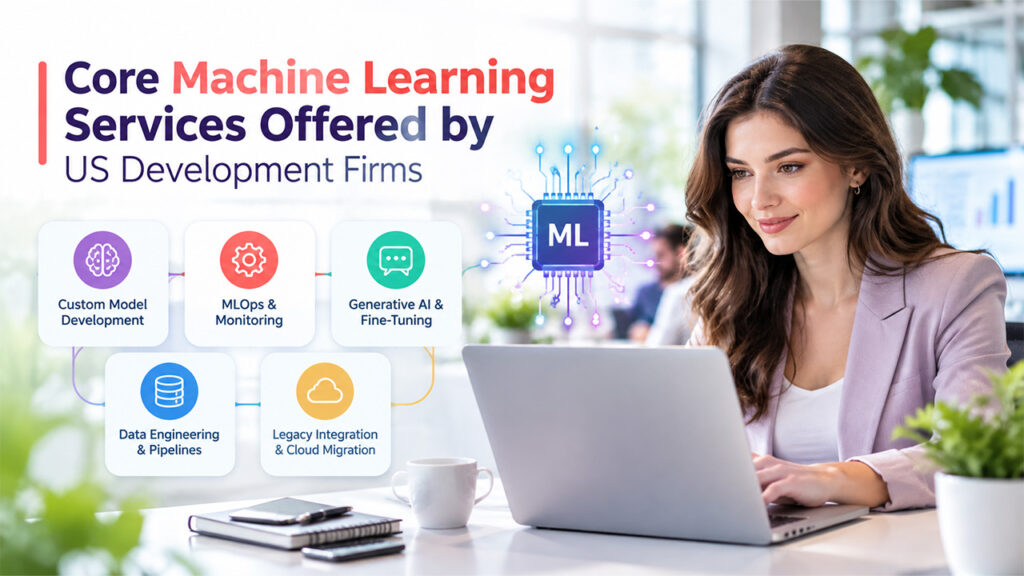
Most vendor websites list the same services. However, what they actually deliver is very different. So, here is what each service really means for your enterprise.
Custom Model Development and Training
Custom model development includes problem framing, feature engineering, model selection, training, and validation against a business metric agreed on before the project starts. The hard part is rarely the algorithm. It is the labeled data, the evaluation setup, and an honest baseline.
So, ask your partner what their non-ML baseline scored. If a rules engine performs within two points of the model, the model adds cost without adding value.
MLOps, CI/CD for AI, and Model Monitoring
MLOps keeps a deployed model accurate after launch. This includes versioned data and models, automated retraining, drift detection, canary releases, and rollback. Software code stays the same. Models don't. They decay over time.
Because accuracy drops silently when upstream data changes, a production ML system needs monitoring on both prediction quality and input distribution. Your alerts should fire on drift, not on customer complaints. Without this layer, every model you deploy loses value with no one tracking it.
Generative AI and Fine-Tuning (LLMs)
Generative AI Development Services work falls into three tiers, each costing more than the last: prompt engineering with retrieval augmentation, parameter-efficient fine-tuning on proprietary data, and full custom training. Almost no enterprise needs the third. Most of the value sits in the first two.
However, there's one thing vendor decks don't tell you. Fine-tuning teaches format and tone well, but it teaches facts poorly. If your model doesn't know your product catalog, you need retrieval and clean source documents, not fine-tuning. And the wrong choice can cost you a quarter.
Data Engineering and Pipeline Architecture
Data engineering builds the ingestion, transformation, storage, and feature-serving layer that models depend on. It takes up most of the effort in a first ML project. And it is also the part buyers try hardest to cut.
But this is exactly where projects fail. Gartner predicts organizations will abandon 60 % of AI projects unsupported by AI-ready data. Not underperform. Abandon. So, treat the feature pipeline as the product and the model as its output.
Legacy Software Integration and Cloud Migration
Integration connects model inference to the systems that run your business, like ERP, CRM, MES, claims platforms, and core banking. If a prediction never reaches an operator's screen, it has produced nothing.
The real problems here are not glamorous. Batch windows block real-time scoring, service identities can't be provisioned, and mainframe extracts arrive six hours late. Thus, scope these in week one, because they shape your architecture more than your model choice does.
Key Questions to Ask Before Hiring an ML Partner
Three questions help you separate partners who have run production ML from those who have only read about it. Ask them in the first call.
Who owns the Intellectual Property and Data Privacy Ownership?
Ask who owns the trained model weights, the derived features, and the labeled dataset when the contract ends. The answer should be you, in writing, for all three.
Then go further. Check if your proprietary data can be used for the vendor's other clients, if any third-party API sees your raw records, and what happens to model artifacts after termination. If a vendor hesitates on weight ownership, they are building lock-in. And you will face it again at renewal.
What is Model Explainability and Governance Standards Offered?
Ask how a specific decision is explained to a regulator, an auditor, or a declined customer. You need a named method like feature attribution, counterfactuals, or documented model cards, not just a promise of transparency.
This is where most programs fall short. Deloitte's April 2026 research across 3,235 business and IT leaders found that only 21 % of enterprises have mature governance models for agentic AI.
That leaves roughly four in five scaling faster than their guardrails. If your partner can't explain their approval workflow, audit log, and human escalation path, they are building a future incident for you.
Proof of Concept (PoC) vs Production Readiness
Ask what changes between their PoC and their production build. A credible answer includes specifics like data contracts, latency budgets, failure modes, retraining cadence, on-call ownership, and cost per thousand inferences.
A PoC is built for a demo on curated data. Production is built for a bad Tuesday, when an upstream schema changes without notice and the model keeps scoring confidently on bad data. So, ask the vendor to walk you through that Tuesday. Their answer will tell you if you're hiring engineers or presenters.
Conclusion
Whether to invest in machine learning is no longer the question. This decision has already been taken, and so has been your competitors'.
Are you moving your next project to another monitored, retrained, audited system which will be used daily by operators, or another proof of concept that looks great in demos but never comes to fruition?
So, choose based on delivery evidence: production references you can call, a clear MLOps approach with named tooling, documented security posture, and clean IP terms. The ten machine learning development companies above cover different parts of that range.
Match the firm to your biggest constraint, whether that is your data, your regulator, or your legacy systems. And scope the first workload narrowly enough to prove value within a quarter.
%201.png)

%201.png)

%201.png)