


Suppose you’re on vacation in another city and decide to have breakfast at a restaurant. During payment, your card declined, and within seconds, your bank sends you a text asking if it was really you trying to make the payment. When you tap “yes”, the transaction goes through before your waiter even notices the delay. Nobody at the bank was keeping an eye on your account. The system did. It was quietly comparing your spending habits against thousands of other patterns and decided in a blink that something looked off and stepped in before any real damage was done.
That's AI in finance, and it is working exactly the way it's supposed to: invisibly, quickly, and in the background.
What Is AI in Finance?
AI in finance refers to using smart technology such as machine learning and natural language processing to help banks, insurers, and investment firms understand huge amounts of data to extract meaningful insights from them.
Instead of a person manually checking every transaction or loan application, these systems analyze past data to learn patterns and use them to make decisions. Over time, they improve themselves and get better at spotting fraud, recognizing risks, and understanding what customers actually need. They often work faster and more accurately than a human could ever do.
Why Is AI in Finance Important for Financial Institutions?
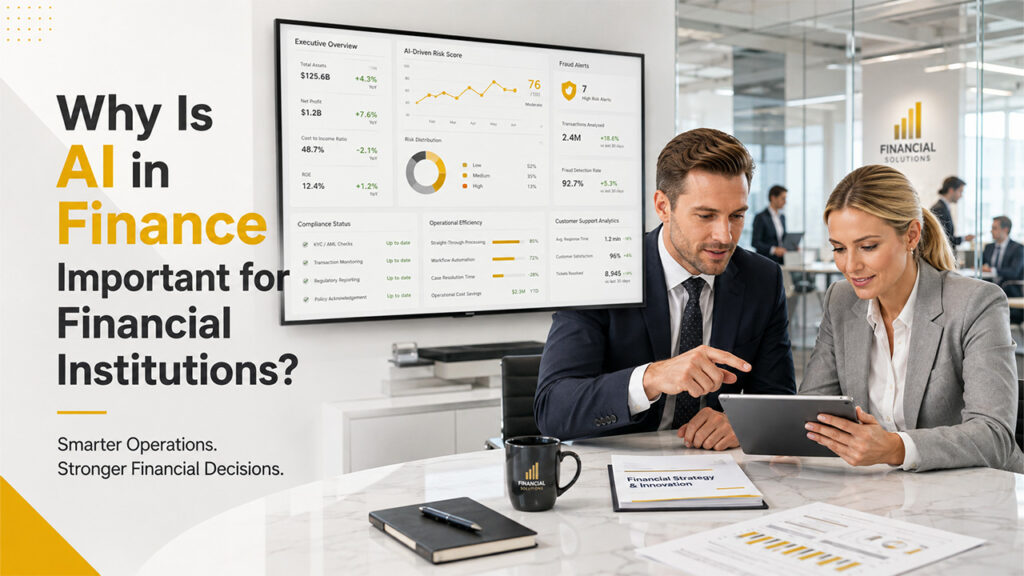
Basically, finance runs on two things: large volumes of data and the need to act on it immediately. That's exactly where AI comes into the picture.
AI Improves Operational Efficiency: AI automates repetitive, manual tasks such as data entry, reconciliations, and routine approvals that eat up time. AI-powered automation reduces errors and frees up human staff for more complex and meaningful work that actually needs a human brain.
AI Strengthens Risk Management: An AI model is better and sharper at spotting credit risk, unusual activity, catching fraud as it happens, and picking up early signs of market volatility. A manual review could never be this efficient in catching and managing risks in real-time. This is because AI models can process more variables at once than a person ever could.
AI Enhances Customer Experience: The AI system never clocks out. The finance industry uses AI chatbot to answer late-night customer inquiries or virtual assistants to offer tailored and personalized financial advice. It allows institutions to respond to customers instantly without making them wait for working hours.
AI Simplifies Regulatory Compliance: Instead of manually tracking every rule change, AI tools can automate monitoring and reporting, helping institutions stay on the right side of increasingly complex regulations without burning out their compliance teams.
AI Gives Financial Institutions a Competitive Advantage: Institutions that use AI to its fullest significantly cut costs, work faster on new ideas, and offer sharper, accurate services to their customers. This is what separates you from the crowd and gives you a competitive advantage.
In simple terms, AI is quickly becoming the engine that fuels smarter, faster, and more scalable financial services. It is revolutionizing how traditional banking and investing work.
How Is AI Used in the Finance Industry?
More than just a single tool, AI is an amalgamation of different technologies that work together across corners of finance. If you're curious about how AI works under the hood, it helps to see that logic in action here. Here's how it actually shows up in day-to-day operations:
Algorithmic Trading: AI-powered systems analyze huge chunks of historical market data, breaking news, and real-time shifts in prices to make trade decisions at a speed that no human trader could match. They often use reinforcement learning to adapt to changing market conditions as they happen.
Automating Financial Workflows: AI automation is used to process expense reports, handle journal entries, and keep compliance in check. AI tools take on high-volume, repetitive everyday tasks or processes to let institutions scale operations without needing to increase headcount at the same rate.
Credit Scoring and Risk Assessment: Rather than relying only on traditional credit history, AI can factor in alternative data like utility payments or rental history, which opens up credit access to people who'd otherwise be overlooked by conventional scoring models.
Insurance Underwriting and Claims Processing: AI scans documents, photos, and other raw, unstructured data to speed up claim decisions, price policies more accurately, and settle insurance claims like a cracked windshield in a fraction of the usual time.
Fraud Detection and Prevention: Deep learning models track transaction behavior in real time, catching anomalies like a sudden large purchase from an unfamiliar location, and they keep adapting as fraud tactics evolve.
Portfolio Management and Investment Strategy: To keep up with changing market trends and tweak portfolios, asset managers are increasingly using AI to stay in the industry. It gives both everyday investors and large institutions access to more sophisticated strategies.
Predictive Analytics and Forecasting: AI models study historical patterns to help institutions predict cash flow needs, forecast market shifts before it actually happens, and plan ahead instead of just reacting to whatever happens next.
Regulatory Compliance and Anti-Money Laundering (AML): AI systems continuously scan transactions and flag any suspicious or unusual activity in real-time. Moreover, it also scans legal documents to help institutions adjust or update their policies as regulations change.
Key Benefits of AI in Finance
The growing adoption of AI is driven by the measurable advantages it brings across financial operations.
Faster Financial Decision-Making: AI processes information in real-time and faster than humans, so decisions that used to take days, like loan approvals or claim settlement, can happen in minutes. This improves efficiency and productivity.
Greater Accuracy: Machines don’t get tired, distracted, or need a break. They can work around the clock and apply the same rules consistently to produce consistent results without any discrepancy. This cuts down on manual errors.
Low Operational Costs: When most of the repetitive tasks are automated, you save resources that are spent on manual review. Additionally, more budget is freed up for other priorities.
Stronger Fraud Detection and Security: AI can catch fraud patterns no matter how sophisticated they are to prevent frauds or scams before they actually cost you. A human reviewer is not as fast as AI to detect fraud.
Personalized Customer Experiences: AI reads human behavior and patterns to recommend services that are tailored to their actual financial behavior, not generic offers that could be ignored by customers.
Improved Financial Inclusion: There are millions of people who don’t have a traditional credit history, so old scoring systems overlook them. AI looks at things like utility bills or rent payments instead. That gives more people a fair shot at credit.
Simplified Regulatory Compliance: Financial rules change constantly, and a human staff can't keep track of every update. It is time-consuming, and they might miss a few important insights. This catches problems earlier and cuts down on costly penalties.
Common Applications of AI in Finance
These benefits become easier to understand when you see how AI is applied across different areas of finance.
Banking: Banks employ AI-powered chatbots to respond to customer questions instantly without making them wait for business hours. Moreover, they also use predictive tools to figure out what a customer might need next based on their previous questions. They also automate boring parts of loan processes that used to take days.
Investment and Trading: In the world of trading, AI scans for patterns in market data that a human analyst might miss or be too distracted to dig through years of price history and news events. This helps firms manage risks better and make faster calls. Some trading systems even react to market shifts in real time, executing trades in fractions of a second.
Lending and Credit Decisions: Instead of relying only on someone's credit score, AI can factor in things like bill payment history, which leads to fairer, faster loan approvals. This is significantly useful to people who’ve never had any traditional credit history, such as students, gig workers, or anyone who’s new to the credit system. It also reduces human bias that used to affect honest and transparent manual reviews.
Financial Planning and Advisory: Wealth managers now use AI tools to fetch a client’s details such as their goals, risk comfort, and market data to offer them smarter and more personal investment strategies. However, AI is not meant to replace the human advisor; rather, it's supporting them by providing sharper insights, so their advice is backed by real data instead of gut feeling alone.
Insurance Industry: Insurance agents use AI to handle claim details, book appointments, and even summarize client meetings, so they can spend more time actually helping people through tricky claims. On the backend, AI also speeds up underwriting and catches fraudulent claims before they cost the company money.
Challenges of Using AI in Financial Services

None of this comes without friction. Financial institutions adopting AI still have real problems to solve:
Algorithmic Bias and Fairness Issues: If the data that is used to train the AI model is outdated, incomplete, or reflects old patterns of discrimination, AI can end up generating outputs that contain those same biases in credit or loan decisions.
Limited Transparency in AI Decisions: Many AI systems work like a “black box”. They produce a decision but do not explain why or how they come to that decision.
Cybersecurity Risks: AI systems that manage sensitive financial information become easy targets for hackers and cybercriminals who are looking to exploit vulnerabilities or steal valuable data for personal gains.
Data Privacy & Protection Concerns: Collecting and analyzing huge volumes of personal financial data raises real questions about who has access, how that data is used, and how it is protected. This is why understanding data for AI matters more than ever in finance.
Regulatory and Compliance Challenges: Rules around AI use in finance are still changing. Moreover, they differ from country to country. This inconsistency makes it difficult to establish global compliance, especially for institutions that operate across multiple markets.
Over-Reliance on AI Automation: Over-reliance on AI without human oversight or judgment can let small errors turn into bigger problems before anyone notices. A missed anomaly today can turn into a costly mistake tomorrow.
Conclusion
AI in finance isn't about replacing bankers, analysts, or advisors with machines. It's about giving them a faster, sharper set of eyes on an ocean of data that is not possible for any human to realistically process alone. The institutions that thrive are the ones that use AI to handle heavy lifting while keeping people in charge of judgment calls, ethics, and the moments that genuinely need a human touch. As these systems keep maturing, the gap between "AI-assisted finance" and "traditional finance" is only going to widen. The real question for any institution isn't whether to adopt AI anymore; it's how responsibly they do it.
FAQs About AI in Finance
Q. What is AI in finance in simple terms?
It's the use of smart technology to analyze financial data, spot patterns, and automate tasks like fraud detection, credit scoring, and customer service.
Q. Is AI replacing human jobs in finance?
Not entirely. AI handles repetitive, data-heavy tasks, while humans focus on judgment calls, relationship management, and strategic decisions that need real oversight.
Q. How does AI help prevent financial fraud?
AI monitors transactions in real time, comparing them to normal spending patterns and flagging anything unusual before it turns into actual financial loss.
Q. Can small businesses benefit from AI in finance?
Yes. AI tools help small businesses with bookkeeping, cash flow forecasting, and fraud protection without needing a large in-house finance team.
Q. What's the biggest risk of using AI in finance?
Algorithmic bias and lack of transparency are major concerns, since flawed data can lead to unfair credit or lending decisions without clear explanations.
%201.png)

%201.png)

%201.png)