
A cold email sequence should do more than remind a prospect that you contacted them.
It should give them several good reasons to start a conversation.
The first email introduces the reason for reaching out. Later messages can add context, share something useful, address a concern, or close the loop. When these emails work together, the sequence feels like one conversation rather than five separate sales pitches.
The process starts before you write the first line. You need the right prospects, a clear campaign goal, a relevant problem, and a reason your offer deserves attention.
For agencies, B2B companies, and sales teams, a planned sequence also makes outreach easier to manage. You know what goes out next, when it goes out, and what you need to measure.
Here is how to build a cold email sequence that gives prospects a genuine reason to reply.
What Is a Cold Email Sequence?
A cold email sequence is a planned series of outbound emails sent to a prospect who has not previously engaged with your business.
A sequence usually contains an initial email followed by several follow-ups. Each message has a different role in moving the conversation forward.
A simple sequence might include:
- Initial introduction
- Context-based follow-up
- Value-focused follow-up
- Objection-focused follow-up
- Final close
There is no fixed number of emails that works for every campaign. Your audience, offer, sales cycle, and response patterns should determine the length.
The important part is progression. A prospect should have a new reason to consider responding each time they receive another message.
Why Does a Cold Email Sequence Need Multiple Emails?
A prospect ignoring your first email does not necessarily mean they are uninterested.
They may have been busy when it arrived. They may have opened it without having time to respond. They may need more information before deciding whether your offer is relevant.
A follow-up gives you another opportunity to provide that context.
However, more emails do not automatically mean more replies. Sending the same pitch repeatedly can make your outreach feel intrusive.
The goal is useful repetition. You want to remain visible while giving the prospect something new to consider.
How Do You Build a Cold Email Sequence?
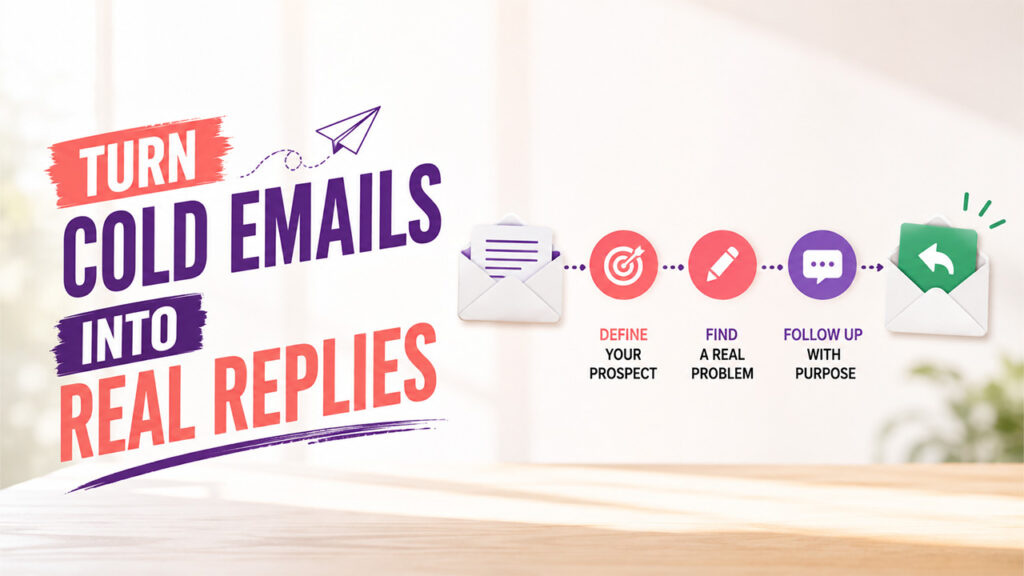
Building the sequence starts with the prospect, not the template.
1. Define Your Ideal Prospect
Start with a clear description of the people and companies you want to reach.
Consider their:
- Industry
- Company size
- Job title
- Location
- Business model
- Growth stage
- Technology
- Likely business challenges
This information affects every part of your campaign.
A cold email aimed at a SaaS founder should not use the same message as one aimed at a sales director in manufacturing.
The more precise your audience, the easier it becomes to explain why your offer is relevant.
2. Choose One Campaign Goal
Give the sequence one primary objective.
You might want to:
- Start a sales conversation
- Book a meeting
- Offer an audit
- Request feedback
- Generate referrals
- Introduce a service
Do not ask the prospect to take several actions in the same email.
If your goal is to start a conversation, your CTA should focus on starting that conversation.
3. Find a Problem Worth Discussing
Your offer needs a connection to something the prospect is concerned about.
Research the company before writing. Look for recent hiring, expansion, product launches, funding announcements, new markets, or changes in their business.
You do not need to mention every detail you find.
One useful observation is enough if it creates a genuine connection between the prospect's situation and your offer.
For example, a company hiring several sales development representatives may need a larger prospect pipeline. That gives an outbound service provider a relevant reason to reach out.
4. Write the First Email
Your opening email should establish relevance quickly.
A useful structure is:
Context → Problem → Offer → CTA
For example:
I noticed your team is hiring several SDRs this quarter. That often creates pressure to keep the pipeline full while new reps are still ramping up.
We help B2B teams generate qualified conversations through outbound email.
Is increasing outbound activity a priority for your team right now?
The example is short because the prospect does not need your entire company history.
They need enough information to decide whether continuing the conversation makes sense.
5. Plan the Follow Ups Before Launching
Write the entire sequence before sending the first email.
This prevents you from creating rushed follow ups that simply say, "Just checking in."
Give each message a specific purpose.
The second email might provide additional context. The third could share a useful observation or example. The fourth can address a common concern. The final email can give the prospect an easy way to close the conversation.
Planning the sequence this way creates a natural progression.
6. End With an Easy CTA
Your first CTA does not need to ask for a long sales meeting.
A simple question can be enough to start the conversation.
Examples include:
- Is this currently a priority for your team?
- Would this be relevant to you?
- Is this something you're looking at this quarter?
- Worth discussing?
The best CTA depends on the offer and the prospect's situation. Keep the requested action proportional to the relationship.
What Should Each Email in a Cold Email Sequence Do?
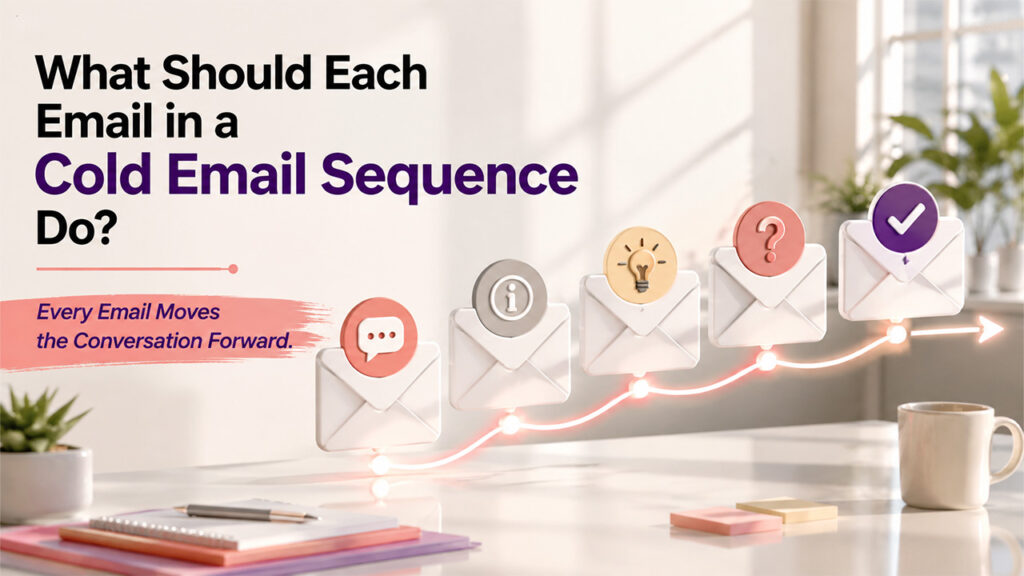
Each email should have a job.
Email 1: Start the Conversation
Introduce the reason for contacting the prospect.
Mention a relevant observation, connect it to a problem, explain your offer briefly, and finish with one CTA.
Avoid turning the first message into a product brochure.
Email 2: Add Context
The first follow-up can explain why you selected the prospect.
You could expand on the problem you noticed or explain what prompted your outreach.
The objective is not to repeat the first email. It is to help the prospect understand the relevance of your offer.
Email 3: Give Something Useful
This email can contain a short example, practical suggestion, industry observation, or relevant resource.
Suppose you sell outbound services to SaaS companies. You might explain how teams can segment prospects before launching a campaign.
Useful information demonstrates expertise without requiring the prospect to book a meeting.
Email 4: Address a Concern
Think about the most common reason prospects hesitate.
They may already have an internal sales team. They may use another platform. They may believe their current process is sufficient.
Address one concern directly and keep the explanation brief.
You are reducing uncertainty, not trying to win an argument.
Email 5: Close the Loop
The final email should provide a clear stopping point.
For example:
I don't want to keep filling your inbox if this isn't a priority. Should I close the loop for now?
This gives uninterested prospects an easy way to say no while creating one final opportunity for interested prospects to respond.
How Should You Space Cold Email Follow Ups?
There is no universal schedule for every audience.
A practical starting point is to leave around two or three business days between early follow-ups. Later messages can have more space.
For example:
| Timing | Purpose | |
| Email 1 | Day 1 | Initial outreach |
| Follow up 1 | Day 3 | Add context |
| Follow up 2 | Day 6 | Provide value |
| Follow up 3 | Day 10 | Address concern |
| Follow up 4 | Day 14 | Close the loop |
The schedule should change when the prospect responds.
Once someone replies, stop the automated sequence and move the conversation into your normal sales process.
How Do You Personalise a Cold Email Sequence?

Personalisation should give the recipient a reason to believe your message is relevant.
Using a first name is not enough.
Better signals include:
- A recent company announcement
- A new product
- Hiring activity
- Expansion into another market
- The prospect's responsibilities
- Their business model
- A problem common to their industry
Compare these two openings:
Hi Sarah, I wanted to tell you about our sales service.
and:
I noticed your team is expanding into the UK market. Are you also increasing outbound activity to support that expansion?
The second opening creates a reason for the conversation.
Good personalisation is specific without becoming intrusive. You should use information that helps explain the outreach, not random facts about the person.
How Can You Improve Cold Email Sequence Deliverability?
A strong sequence still needs a healthy sending setup.
Before launching a campaign, check your:
- SPF
- DKIM
- DMARC
- Sender reputation
- Domain reputation
- Bounce rate
- Sending volume
- Email list quality
- Unsubscribe handling
Verify addresses before sending and remove invalid contacts from your campaigns. Combining strong deliverability practices with email marketing automation can also help businesses manage personalized campaigns and follow-ups more efficiently.
Your sending infrastructure also becomes more important as campaign volume grows. Teams running multiple outbound campaigns may use separate domains, multiple mailboxes, controlled sending limits, and monitoring to keep their outreach organised.
Deliverability should be treated as part of the campaign strategy rather than something to fix after emails start landing in spam.
What Are the Biggest Cold Email Sequence Mistakes?
Several mistakes can undermine an otherwise strong campaign.
Sending Too Much Too Quickly
A prospect needs time to read and respond. Several messages arriving within a short period can make the campaign feel aggressive.
Repeating the Same Pitch
Changing a few words does not make a follow-up different.
Each message should introduce a new reason to respond.
Writing Long Emails
Cold emails compete with a busy inbox.
Keep each message focused on one problem, one idea, and one action.
Overdoing Personalisation
Personalisation becomes counterproductive when it feels forced.
A relevant business observation is usually more useful than a paragraph about the prospect's background.
Asking for Too Much
A one-hour meeting can be a significant commitment for someone who has never spoken with you.
Start with a smaller request when appropriate.
Ignoring Deliverability
Poor technical setup and low-quality contact lists can prevent good emails from reaching the inbox.
The copy cannot solve an infrastructure problem.
How Do You Measure a Cold Email Sequence?
Reply volume alone does not tell you whether the campaign is working.
Track several stages of the process:
- Delivery rate
- Bounce rate
- Reply rate
- Positive reply rate
- Meeting rate
- Qualified opportunity rate
- Unsubscribe rate
- Conversion rate
Positive replies are more meaningful than total replies because not every response represents genuine interest.
You should also compare performance across different audiences, offers, sending accounts, and sequence variations while using sales pipeline management to track how qualified replies progress toward meetings and opportunities.
How Can You Build a Cold Email Sequence With EmailBison?
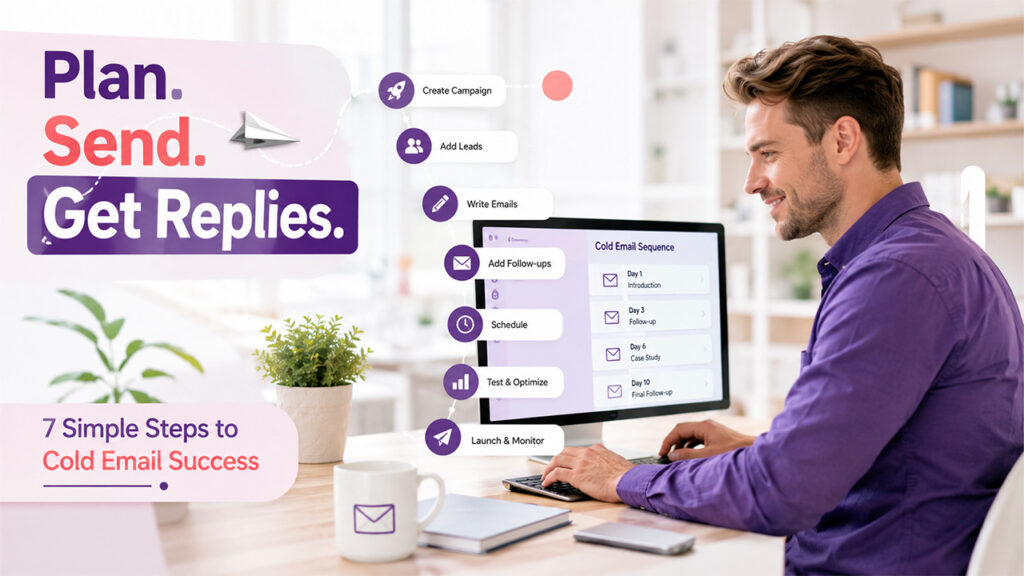
Building a cold email sequence with EmailBison involves setting up your campaign, adding prospects, creating your emails, configuring sending, and monitoring results.
- Create your campaign: Start by creating a new campaign and giving it a clear name based on your audience or offer. Your campaign brings the emails, leads, and sending schedule together in one place.
- Add and segment your leads: Import prospects individually or in bulk using CSV. You can also add custom variables such as company, job title, industry, or other personalisation data.
- Write the initial email: Keep the first message short and focus on the prospect's problem or potential value. Use personalisation variables and, where appropriate, spintax or Liquid syntax to create natural variations.
- Add follow-up steps: Build a multi-step sequence with specific delays between emails. You can also create variants to test different messaging and configure follow-ups to remain in the same email thread.
- Set your sending schedule: Choose your sending days, hours, time zone, and daily volume. EmailBison's scheduler distributes campaign emails throughout the selected sending window rather than sending them all at once.
- Test and optimise your emails: Before launching, test your sequence and review available inbox-placement and campaign diagnostics. Monitor sends, bounces, replies, and other campaign outcomes to identify areas that need improvement.
- Launch and monitor replies: Once your campaign, leads, sequence, and schedule are ready, launch the campaign. Monitor replies and move interested prospects into the appropriate sales or follow-up workflow.
A simple sequence might look like this:
- Day 1: Personalised introduction and value proposition
- Day 3: Short follow-up addressing a specific pain point
- Day 6: Relevant result, case study, or resource
- Day 10: Final low-pressure follow-up
What Does a Cold Email Sequence Template Look Like?
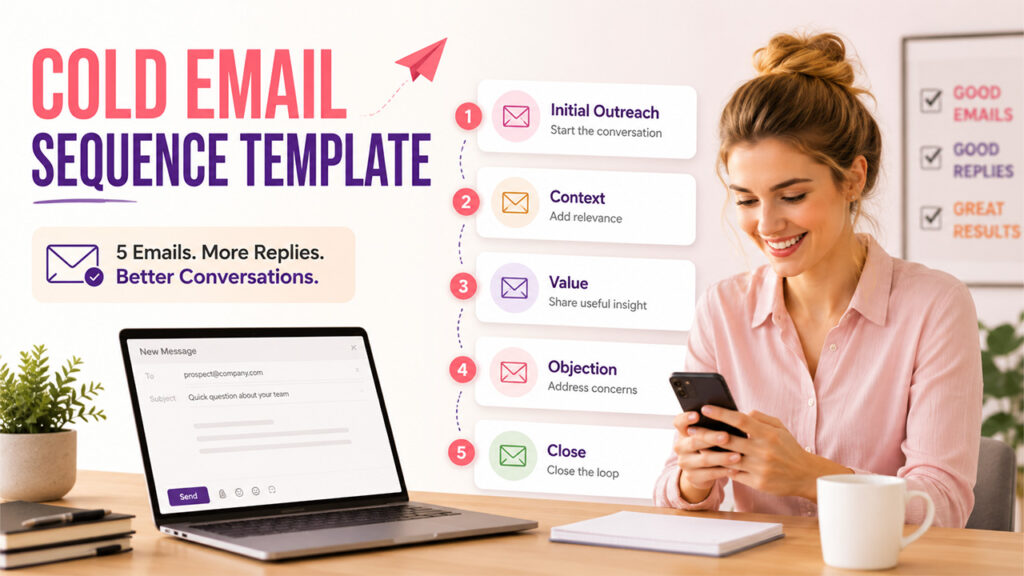
A simple five-email sequence can provide a useful starting point.
Email 1: Initial Outreach
Subject: Quick question about {{Company}}
Hi {{First Name}},
I noticed {{relevant observation}}.
Companies dealing with {{specific situation}} often face {{specific problem}}.
We help {{type of company}} with {{specific outcome}}.
Would this be relevant for your team?
Email 2: Context
Hi {{First Name}},
One reason I reached out is {{specific reason connected to their business}}.
Teams in {{industry}} often run into {{problem}} when {{situation}}.
Is this something you're currently working on?
Email 3: Value
Hi {{First Name}},
One thing we've noticed with {{company type}} is {{useful observation}}.
A simple way to address it is {{brief practical suggestion}}.
Would it be useful to compare notes?
Email 4: Objection
Hi {{First Name}},
A common concern we hear from {{similar companies}} is {{objection}}.
{{Brief response to that concern.}}
Would it make sense to discuss?
Email 5: Close
Hi {{First Name}},
I don't want to keep filling your inbox if this isn't a priority.
Should I close the loop for now?
Best, {{Name}}
The template should be adapted to the audience and offer. Copying the same wording across unrelated industries usually makes personalisation obvious.
What Makes a Cold Email Sequence Get Replies?
A reply-focused sequence does not depend on one clever sentence. It depends on several decisions working together.
The prospect needs to be relevant. The opening needs to explain why you reached out. The offer needs to connect with a recognisable problem. Follow ups need to provide something new. The CTA needs to make responding easy.
Behind all of this, the sending setup needs to protect deliverability. When these pieces work together, the sequence stops feeling like a string of automated sales messages. It becomes a structured way to start a relevant business conversation.
Why Choose EmailBison for Cold Email Sequences?
EmailBison is built specifically for teams that want to run cold email campaigns at scale while maintaining control over deliverability and follow-up automation.
- Build multi-step sequences: Create automated campaigns with scheduled follow-ups, variants, and flexible sending controls.
- Personalize at scale: Use Spintax, Liquid syntax, custom variables, and conditional content to make automated emails more relevant and natural.
- Protect deliverability: EmailBison offers inbox-placement testing, bounce protection, unsubscribe handling, and infrastructure designed around cold-email deliverability.
- Keep follow-ups in the same thread: Interested leads can automatically enter follow-up campaigns without starting a new conversation, making ongoing outreach feel more natural.
- Optimize campaigns with real-time data: Monitor sends, bounces, and campaign outcomes so you can identify problems and improve underperforming sequences.
- Scale without complicated workflows: Manage multiple campaigns, sender accounts, and workspaces from one platform, with API access for custom automation.
Frequently Asked Questions
Q1. How many emails should a cold email sequence contain?
There is no fixed number for every campaign. Four to six emails can provide enough opportunities to start a conversation without making the sequence unnecessarily long.
Q2. How many days should you wait between cold email follow ups?
Two to three business days is a practical starting point for early follow ups. Later messages can have more space. Test timing based on your audience and response data.
Q3. What should the first cold email include?
The first email should explain why you are contacting the prospect, identify a relevant problem, briefly introduce your offer, and end with a simple CTA.
Q4. Should every cold email follow-up be different?
Yes. Each follow-up should add new context, information, an example, or address a relevant concern. Repeating the same pitch rarely gives prospects a new reason to respond.
Q5. How can I personalise cold emails without spending too much time?
Start with a small number of relevant signals, such as company growth, hiring, product launches, or industry changes. Use those details to explain why the prospect belongs in your campaign.
Q6. Should I automate cold email follow-ups?
Yes. Automation can keep follow ups consistent and save time across campaigns. Just make sure the sequence stops when a prospect replies, and every message remains relevant.
Q7. How do you measure a cold email sequence?
Track delivery, bounce rate, replies, positive replies, meetings, qualified opportunities, unsubscribes, and conversions. These metrics show whether your outreach is producing meaningful sales activity.
Q8. Can EmailBison create cold email sequences?
Yes. EmailBison provides tools for creating and managing multi step cold email campaigns, automating follow ups, managing sending accounts, organising campaigns, and monitoring campaign activity.
%201.png)

%201.png)

%201.png)