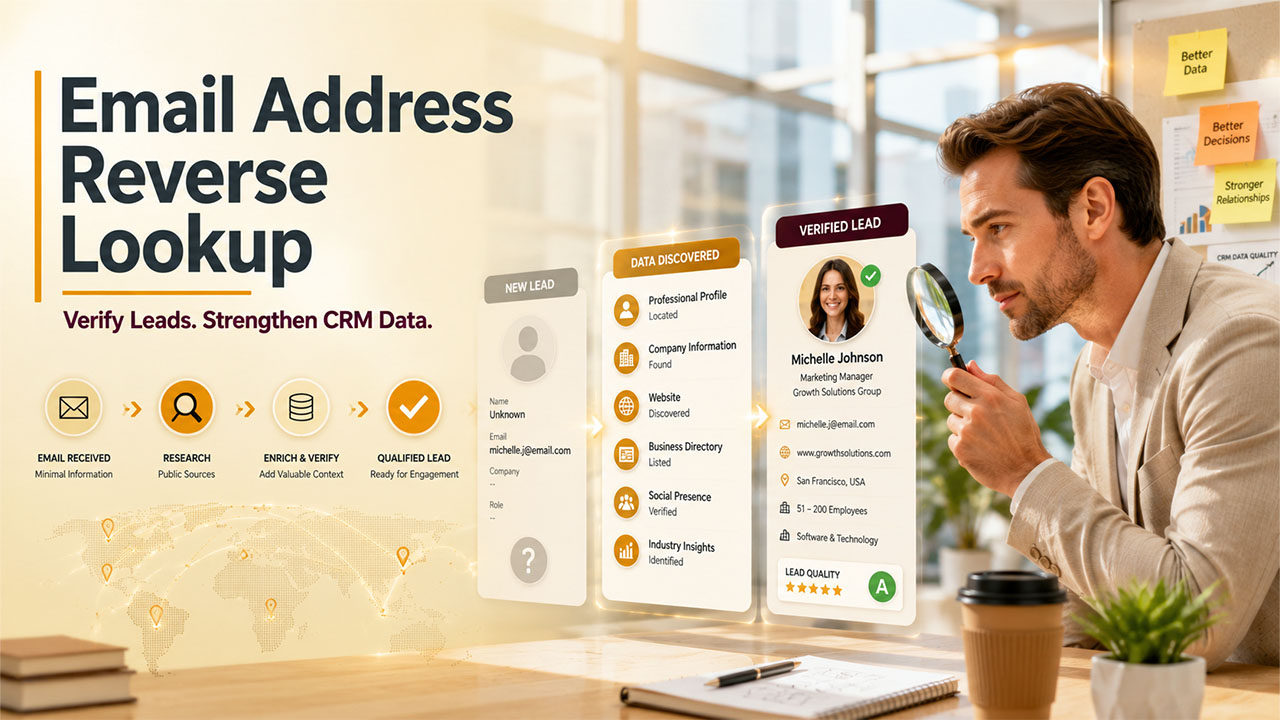

Reliable information is the foundation of customer relationship management software. It is an important asset for sales businesses, customer experience, marketing, or partnerships. Why, you ask? Because every decision depends on the quality of data that is stored in your CRM.
Almost always, email emerges as the first and sometimes only piece of information that you get about a new lead. To confirm that the contact is real and not a scam; teams use email to verify the contact. After confirming, they begin sales conversations or a marketing campaign.
This is where email-based research becomes valuable. Using reverse email lookup, businesses can access publicly available information, find genuine contacts, and make informed decisions that remove the unwanted friction from the sales process. Remember that it does not replace CRM systems. It complements them by providing additional context. It helps teams decide which opportunities are worth the attention.
Why CRM Data Quality Directly Impacts Business Growth
A CRM system is just as valuable as the information it stores. If customer records are not updated, incorrect, or incomplete, they can cause problems across every department and stage:
- Sales teams won’t know which lead is important, and they spend time chasing low-quality leads.
- Marketing campaigns target the wrong audience.
- Customer success managers lack useful context.
- Business development teams struggle to qualify partnership opportunities.
If this continues, poor data quality will add acquisition costs while significantly reducing conversion rates. To improve CRM data does not mean you have to gather more information from customers. There's another way. You can improve the quality of CRM data by using publicly available data in a more effective and better way.
The Email Address as a Business Identifier
Unlike phone numbers or physical addresses, email addresses are frequently used across professional platforms, company websites, business communities, and online services.
Because of this, an email address often serves as a practical starting point for research.
Depending on publicly available information, businesses may be able to identify:
- Professional profiles
- Company affiliations
- Public websites
- Business directories
- Mentions across online platforms
- Other publicly visible digital footprints
This additional context helps teams understand who they're communicating with before investing additional sales or marketing resources.
Practical CRM Use Cases for Email Address Reverse Lookup

1. Lead Qualification
Sales representatives often receive inbound inquiries from unfamiliar contacts.
Before scheduling meetings, they may want to understand whether a prospect appears to represent a legitimate company or business.
A reverse email search provides another layer of context during early qualification.
2. Contact Enrichment
Many CRM records begin with very little information:
- First name
- Email address
- Company name (sometimes)
Instead of relying solely on forms completed by prospects, organizations can enrich customer profiles using publicly available information where appropriate and create CRM records from emails more efficiently.
This enables more personalized communication without requiring additional outreach.
3. Partnership Verification
Marketing agencies, SaaS companies, consultants, and technology vendors frequently receive collaboration requests.
Before allocating resources, teams often perform lightweight due diligence.
Understanding whether an email is associated with an established online presence can help prioritize conversations more effectively.
Email Address Reverse Lookup and Sales Productivity
Every sales team faces the same challenge: limited time.
Representatives need to identify which leads deserve immediate attention while avoiding hours spent researching contacts manually.
A structured verification process can streamline this workflow.
| Sales Activity | Benefit of Additional Email Research |
| Qualifying inbound leads | Better prioritization |
| Preparing discovery calls | More personalized conversations |
| Reviewing partnership requests | Additional confidence before engagement |
| Updating CRM records | Improved data quality |
| Account-based sales | Richer customer profiles |
Even small improvements in lead quality can have a measurable impact when applied across hundreds or thousands of contacts.
Supporting Automation with Better Data
Automation is one of the biggest advantages of modern CRM platforms. Integrating email communication through CRM Software Outlook Integration helps businesses synchronize customer interactions, improve productivity, and maintain accurate contact records.
Businesses automate:
- Lead routing
- Email campaigns
- Customer onboarding
- Follow-up reminders
- Pipeline management
- Customer segmentation
However, automation performs best when the underlying data is accurate.
Poor-quality records don't become better simply because they're automated—they become poor-quality processes executed at scale.
Adding an initial verification step before contacts enter automated workflows can improve downstream efficiency throughout the customer lifecycle.
Where ClarityCheck Can Support the Process

Businesses that want to find additional information about new or unfamiliar contacts often use specialized research tools alongside their CRM.
ClarityCheck is one example of a platform designed to organize publicly available online information connected to identifiers such as email addresses, phone numbers, images, and other searchable data.
When teams need an email address reverse lookup, tools like ClarityCheck can provide a useful starting point for gathering publicly available information before deciding whether additional verification is necessary.
Rather than replacing CRM software, these services complement existing sales and customer management processes by helping users perform faster preliminary research.
For organizations handling large numbers of inbound leads or partnership requests, integrating lightweight research into the qualification process can save valuable time.
Best Practices for Responsible Contact Research
Email address reverse lookup should always be used responsibly and as part of a broader decision-making process.
Verify Information Across Multiple Sources
You must first verify information that is available on public platforms as it might be incorrect, outdated, or incomplete. Do not make important business decisions solely based on a single search result. Your confidence in the available information will increase once you cross check it across multiple reputable sources.
Respect Privacy Regulations
Organizations should make sure that their research does not violate any applicable privacy laws and internal data governance policies. The goal here is to understand publicly available information more clearly; not to access private or confidential data.
Avoid Making Assumptions
Do not always assume the worst-case scenario. If someone has a limited presence, it does not necessarily mean that they are less credible. Likewise, a strong digital footprint should not automatically be interpreted as proof of legitimacy. Context matters, and email research should be viewed as one component of a broader evaluation process.
Building Better Customer Relationships Starts with Better Information
Automation, visual dashboards, and sales pipelines do not always signal that your CRM strategies are successful. They rely on information that is accurate, credible, and can help teams make informed decisions backed by high-quality data.
Email Address Reverse Lookup supports this objective. It allows businesses to get additional context before they decide to invest their time, sales efforts, or marketing resources into a new customer relationship.
Whether you want to qualify inbound leads, find information about potential partners, enrich your CRM records, or prepare for conversation with customers; publicly available email-based research can improve efficiency while reducing uncertainty.
Solutions such as ClarityCheck, if used thoughtfully alongside CRM platforms, can help businesses improve their data quality, streamline qualification workflows, and strengthen customer relationship management through more informed decision-making.
%201.png)

%201.png)

%201.png)