
After years of working across CRM, marketing automation and lifecycle programs, one thing becomes fairly clear: the maturity of a lifecycle program has very little to do with the number of journeys running in the platform.
A brand can have hundreds of campaigns, sophisticated segmentation and an enterprise marketing platform, yet still struggle to answer a basic question: why did this customer receive this message today? In more mature programs, that answer is usually tied to a combination of customer state, recent behavior, historical interactions, and a defined business objective. The difference is not necessarily the technology. It is how effectively the organization has connected its customer data to decisioning and activation.
This is where lifecycle programs tend to evolve. Early CRM programs use customer data primarily to build audiences. As the operating model matures, those same signals start triggering journeys, changing customer treatment and eventually influencing decisions based on what a customer is likely to do next. The CRM moves from being primarily a system of record to becoming an active part of the marketing decisioning layer.
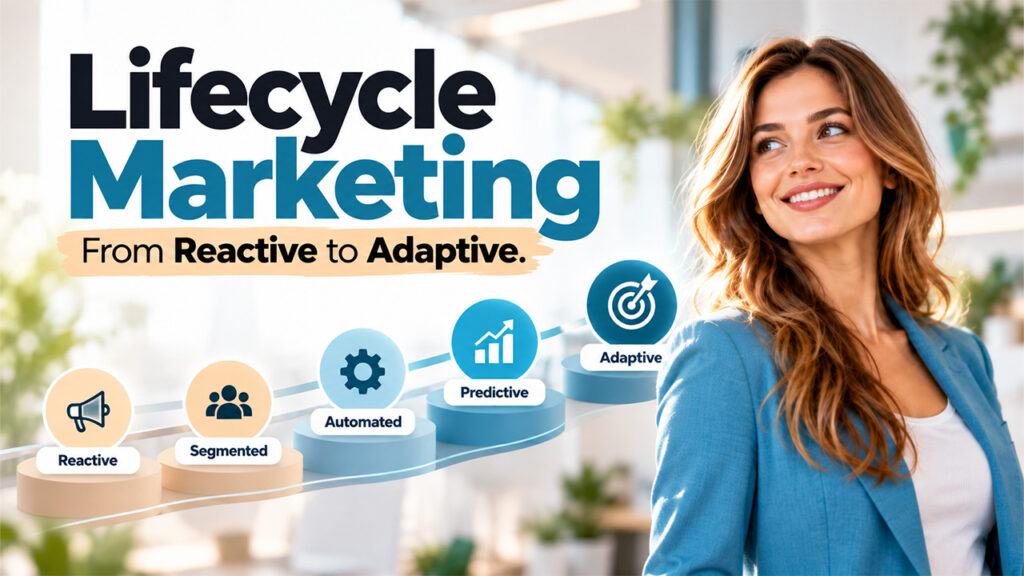
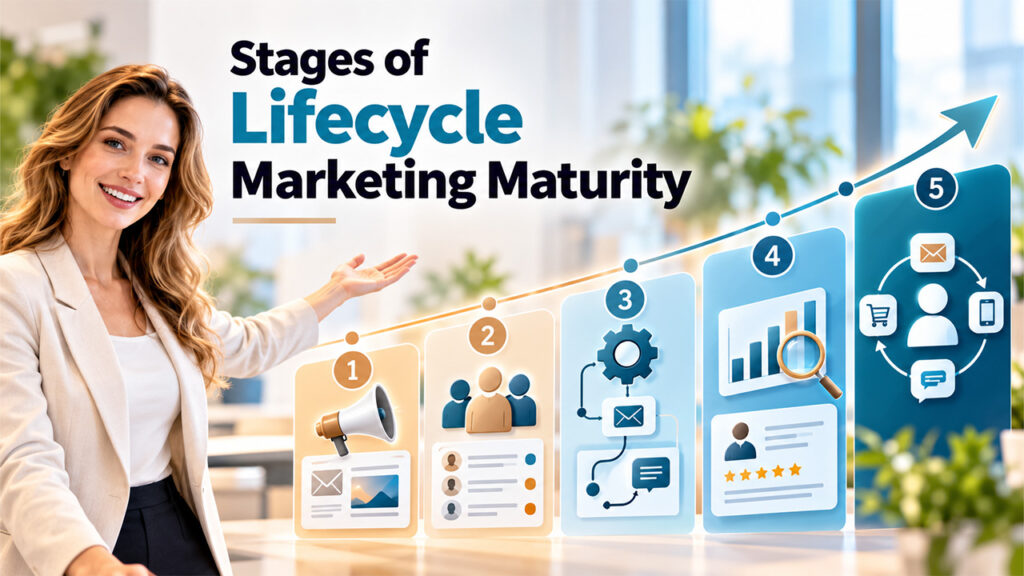
We use five stages to describe that progression: Reactive, Segmented, Automated, Predictive, and Adaptive. These aren’t technology categories, and reaching the fifth stage isn’t necessarily the objective for every brand. They provide a practical way to assess how far a lifecycle program has progressed from campaign execution toward connected, data-driven customer decisioning.
What Is Lifecycle Marketing?
At its simplest, lifecycle marketing means making customer context part of the marketing decision. A new subscriber, a first-time buyer, a loyal customer, and someone showing signs of disengagement shouldn’t all enter the same marketing motion simply because they happen to sit in the same database.
Making that work at scale requires considerably more than a collection of campaigns. Customer identity, behavioral events, transactional data, lifecycle states, segmentation, journey logic, channel preferences and, increasingly, predictive signals need to work together. When those components are disconnected, the customer experience usually reflects it- different teams use different definitions of an active or engaged customer, journeys compete for the same audience, and marketers spend significant time managing campaign mechanics that should already be handled by the system.
For us, lifecycle maturity is therefore less about how many campaigns a brand runs and more about how much of the customer decision can be informed by data, how reliably that decision can be activated, and how effectively the resulting behavior feeds back into the next decision.
The 5 Stages of Lifecycle Marketing Maturity
1. Reactive: The Campaign Calendar Drives the Customer Experience
At the Reactive stage, marketing is predominantly organized around business events rather than customer states. Promotions, product launches, seasonal campaigns, and newsletters determine the communication calendar, while CRM data is primarily used to create audiences, apply exclusions, and report on campaign performance.
There may be a significant amount of customer data available, but relatively little of it is being used as an active signal. A customer who purchased yesterday and a customer who has been inactive for six months may still receive the same promotional campaign because the campaign, rather than the customer lifecycle, is driving the interaction.
This is usually less a technology problem than an operating-model problem. The organization has not yet translated its customer lifecycle into measurable states and signals that the CRM can act upon. Marketing remains focused on what the business wants to communicate, rather than what the customer is doing and what the next appropriate interaction should be.
2. Segmented: Better Targeting, But Still Marketer-Dependent
Segmentation is generally the first meaningful step toward lifecycle maturity. Customers are grouped using attributes such as geography, plan, tenure, acquisition source, product ownership, purchase history, or customer value, and those segments begin to influence content and campaign strategy.
The limitation is that segmentation often remains static. A marketer defines the audience, builds the campaign, schedules the communication, and eventually revisits the segment when the next campaign comes around. Even when the segmentation itself is sophisticated, the operating model remains largely batch-based.
Technically, the organization has moved from treating the database as one audience to treating it as multiple audiences. It has not yet moved to treating customer behavior as a continuous stream of signals.
That distinction matters because lifecycle marketing is fundamentally about state change. A customer moves from prospect to customer, customer to active user, active to at-risk, at-risk to churned, or churned to reactivated. The marketing system needs to recognize those transitions rather than waiting for the next campaign cycle.
3. Automated: Events Begin Driving Orchestration
Automation is where the lifecycle architecture starts becoming materially different. Customer events can now initiate, interrupt, or redirect journeys without a marketer manually constructing an audience each time.
A signup can initiate onboarding. A purchase can trigger a post-purchase sequence. A change in subscription status can alter the customer’s journey. A period of inactivity can initiate re-engagement. A product event can move a customer into an education or adoption path.
The important technical shift is not simply that emails are automated. It is that customer data has become an input to orchestration. At this stage, mature implementations start paying much closer attention to event schemas, identity resolution, journey eligibility, entry and exit criteria, suppression rules, contact policies and cross-channel coordination. Without those foundations, automation simply scales inconsistent logic.
There is another limitation, however: most Stage 3 programs remain deterministic. The decision tree may be complex, but the underlying model is still generally “if this happens, do that.” A customer enters a particular condition and receives a predefined treatment. That works extremely well for many use cases, but it becomes restrictive when customers who look similar on paper begin exhibiting very different future behavior.
4. Predictive: The System Starts Optimizing for What Happens Next
Predictive lifecycle marketing introduces a different class of signal. Instead of relying only on observed behavior, the system begins incorporating probabilities and propensity- likelihood to churn, likelihood to purchase, predicted lifetime value, product affinity, or next-best-action recommendations.
This changes the architecture because predictive outputs need to become activation-ready data, not simply analytical outputs. A churn model sitting in a data warehouse does not make a CRM program predictive. The score has to be available at the right granularity, refreshed at an appropriate frequency, and exposed to the orchestration layer in a way that can actually change customer treatment. If a high-risk customer receives exactly the same journey regardless of their churn propensity, the model is providing analytical insight but not lifecycle decisioning.
This is also where the relationship between CRM, analytics, and data engineering becomes much more important. Predictive lifecycle programs require a feedback loop between behavioral data, models, activation and outcomes. Model outputs influence customer treatment; customer responses generate new data; that data can then be used to improve subsequent decisions.
The marketing platform therefore becomes one component of a broader decisioning architecture rather than the entire architecture itself.
5. Adaptive: Lifecycle Becomes a Continuously Evolving Decision System
Adaptive lifecycle marketing is the most advanced stage because the system can respond to changing customer context rather than simply execute a fixed journey.
At this point, decisioning can incorporate multiple signals simultaneously: recent engagement, transaction history, product behavior, customer value, propensity, channel preference, and other contextual data, to determine the most appropriate next interaction. Content, timing, channel, or offer can change based on the individual rather than being determined entirely by a predefined segment.
The important distinction is that adaptive does not mean adding more personalization rules. It means creating an architecture in which decisions can change as customer context changes.
That requires mature data pipelines, strong identity resolution, real-time or near-real-time event processing where appropriate, decisioning capabilities, experimentation and measurement. It also requires governance. The more dynamically a system can make decisions, the more important it becomes to define frequency controls, eligibility rules, fallback treatments, consent and channel constraints.
This is why Stage 5 remains relatively uncommon. The challenge isn’t generating another personalized message. It is building the infrastructure and operating model that can make thousands of customer-level decisions consistently without creating a fragmented or uncontrolled customer experience.
The Maturity Gap Is Usually in the Architecture

One of the patterns we see repeatedly is a significant gap between platform capability and lifecycle maturity.
A brand may have invested in an enterprise CRM and marketing automation platform with sophisticated segmentation, orchestration, personalization, and AI capabilities, but the implementation has evolved campaign by campaign. Different teams maintain different customer definitions. Events are inconsistently named or captured. Some attributes update in real time while others are refreshed through batch processes. Journey logic has accumulated over several years, and nobody has a complete view of how one journey affects another.
In that environment, adding another capability rarely solves the underlying problem.
The first step is usually to establish a common customer and lifecycle model: what constitutes an active customer, what signals indicate risk, which events represent meaningful behavioral changes, which attributes should be authoritative, and which system owns each piece of data. Once those foundations are established, orchestration becomes considerably more powerful because the marketing platform is operating from a consistent representation of the customer.
This is also why we would caution against treating AI as the next automatic stage of CRM maturity. AI can improve decisioning, content selection, recommendations, and prediction, but it does not remove the need for clean customer data, reliable event architecture, or well-defined lifecycle logic. In many organizations, the highest-value work is still relatively unglamorous: fixing identity, rationalizing events, removing conflicting audience definitions and redesigning journey governance.
The sophistication comes from what the system can reliably decide, not from how many capabilities are switched on.
What Actually Moves a Brand Up the Curve?
Moving up the lifecycle maturity curve isn’t about implementing every feature a marketing platform offers. The starting point is the customer lifecycle itself: define the states that matter, identify the signals that indicate movement between those states, establish which decisions should be automated, and determine where CRM in Digital Marketing can help connect customer data with meaningful business decisions.
The next step is the less visible but more important work of making the data usable. Customer identities need to be resolved, event definitions need to be consistent, lifecycle attributes need clear ownership, journey entry and exit criteria need to be rationalized, and data needs to reach the activation layer with the right frequency and reliability. Only then does it make sense to introduce more sophisticated decisioning.
For some organizations, maturity may simply mean moving from batch segmentation to event-triggered journeys. For others, it may mean introducing predictive churn signals into an existing retention program. At a more advanced level, the opportunity may be to connect decisioning across email, push, SMS, web, and other channels so that they respond to the same customer state rather than operating as separate programs. The technology matters, but it is rarely the starting point.
The real progression is from campaigns to segments, segments to events, events to decisions, and decisions to continuously optimized customer experiences. Each step requires stronger data foundations and more deliberate lifecycle architecture.
That is ultimately what separates a sophisticated CRM program from a sophisticated CRM platform.
The objective here is to build a system that can consistently make better customer decisions, using the right data, at the right point in the lifecycle, with enough intelligence to adapt as the customer changes. At Mavlers, we work with brands on that progression- connecting CRM data, lifecycle strategy, journey orchestration, and marketing technology to help teams move from campaign execution toward a more connected, measurable lifecycle operating model.
%201.png)

%201.png)

%201.png)