
One Monday morning, you open your laptop, watch a tutorial video, and by the third video you’re copying code that you don’t even understand properly just to keep up. A week later, you’ve forgotten half of it and watched a tutorial again. If this happens to you, then you’re not alone. Thousands of beginners experience this every year, and it’s rarely because JavaScript is too hard. It's because the method didn’t fit the person. JavaScript still runs most of the interactive web, from dropdown menus to entire apps, and it remains one of the most in-demand skills in tech. But learning it well needs the right combination of methods and sticking with them long enough to see results.
This guide walks you through the best ways to learn JavaScript, so you can skip the trial and error and start with what actually works.
What Is JavaScript?
JavaScript is a programming language that makes websites do things. HTML gives a webpage its structure, and CSS makes it look good, but JavaScript is what makes it respond. For instance, a menu that opens when you click it, a form that checks your email address before you submit it, and a game that reacts to your keyboard. Additionally, many developers pair JavaScript with dedicated Web Design Tools to build and style pages faster.
You don’t need any special software to start using it, as it runs directly inside your web browser. Beyond websites, JavaScript now powers mobile apps, browser games, and even backend servers, which is part of why it's stayed so popular for so long.
Why Should You Learn JavaScript in 2026?
There are so many programming languages available out there. So, it is worth asking why this one particularly deserves your time. Here's why both beginners and career-changers prefer JavaScript:
- It Is Used Across the Modern Web: Today, nearly every website uses JavaScript in one form or another. So, the skills transfer across almost any web project you’ll work on.
- It Is Beginner-Friendly to Learn: You don't need to install anything complicated that increases your cognitive load. All you have to do is open a browser, then open a text editor, and you can write your first line of code in minutes.
- It Offers Versatile Career Opportunities: The same language that builds a webpage's interactivity can also build mobile apps, games, and server-side tools. So, you can use it across diverse fields.
- It Has a Large Developer Community: It has an active online community. So, when you get stuck and most definitely, you will, there’s a good chance that someone else has already addressed the same problem online.
- JavaScript Skills Are in High Demand: Companies of every size, from small startups to major corporations, need people who know JavaScript, and that demand isn't slowing down.
5 Best Ways to Learn JavaScript in 2026
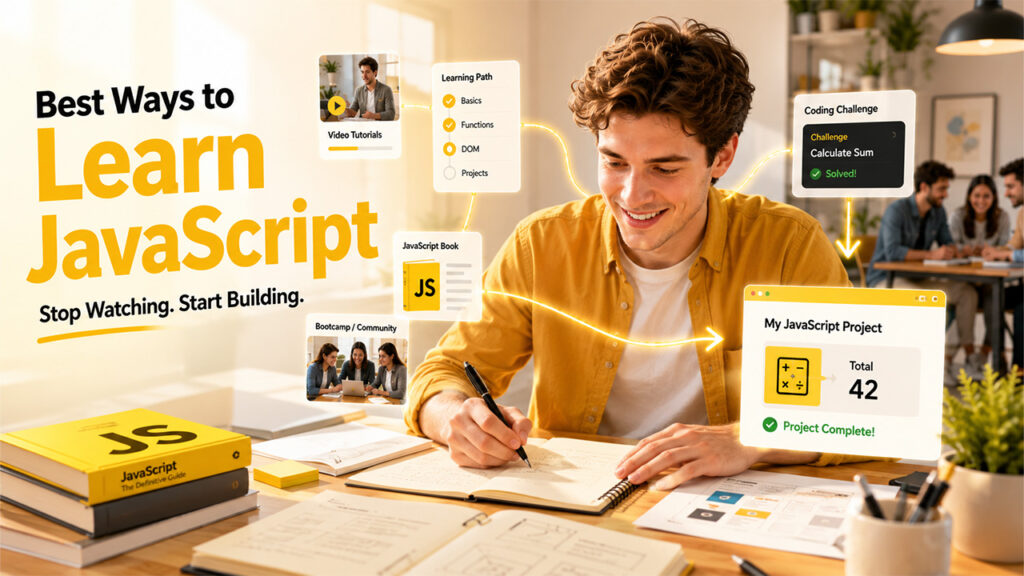
Remember that methods on this list don’t work as well alone as they do together. Keep this in mind while you read through them: they’re not seven separate options, but pieces that you can combine based on how you actually learn.
1. Structured Online Courses
Most beginners prefer to start with a structured course because someone else has already arranged the order things should be taught in. You don’t have to guess what to learn next. You just have to follow a path that has been tested on thousands of other learners before you. Good courses combine short lessons with small coding exercises to practice. This way, you’re not just watching someone else type but get to do it on your own, too. Many courses are self-paced, which matters if you have a job or other commitments to keep up with. However, the downside is that courses alone won’t be enough to prepare you for a job. They are the foundation, not the finish line.
- Codecademy's Introduction to JavaScript
- The Complete JavaScript Course on Udemy
- freeCodeCamp's JavaScript curriculum
- Scaler's JavaScript course for beginners
If you're curious about how other languages compare, it's worth glancing at Python Web Frameworks once you're comfortable with JavaScript basics.
2. Coding Challenge Platforms
Once you’ve mastered the basics, challenge platforms give you the opportunity to actually use them instead of just recognizing them when you see them again. These sites give you a small problem to solve, such as reversing a string, sorting a list, and building a simple calculator. They let you solve them in your own different ways. Sure, you’ll get stuck, but when you do, you can look things up and slowly get faster at solving them. Some learners now practice alongside an LLM for Coding to get instant feedback while solving problems.
This is where the language starts to feel less like memorized syntax and more like a tool you actually know how to use.
- Codewars
- JSchallenger
- HackerNoon's practical JavaScript challenges
- GitHub's JavaScript coding challenge repositories
3. Books and Written Guides
Books might not be as flashy as videos, but they force you into a kind of slow and careful reading that sticks with you longer. A well-written JavaScript book not only explains what the code does, but why the language works the way it does. That's valuable, especially once you move past the basics and want to understand concepts like closures or asynchronous code properly instead of half-guessing them. Books also work well as reference material you can return to months later for deeper explanation, long after a video course has faded from memory.
- Eloquent JavaScript by Marijn Haverbeke
- JavaScript: The Definitive Guide by David Flanagan
- You Don't Know JS Yet by Kyle Simpson
- JavaScript and JQuery by Jon Duckett
4. Coding Bootcamps
If you want to change your career and need structure, speed, and accountability, top coding bootcamps are built exactly for that. They are full-time, intensive programs where experienced instructors guide and push you through real projects instead of isolated exercises. Moreover, beyond the curriculum, its biggest advantage is the environment. You're learning alongside other people who are also trying to learn quickly. Additionally, most bootcamps offer career support like resume help and interview prep. It's a bigger commitment than a self-paced course, both in time and cost, but it compresses months of scattered learning into a focused stretch.
- Fullstack Academy's coding bootcamp programs
- Flatiron School
- Coding Dojo
- Hack Reactor
5. YouTube Tutorials and Video Courses
Some people learn far better by watching someone build something in real time than by reading documentation. That's where video tutorials shine. Watching an experienced developer talk through their thought process, including their mistakes. They teach you things a written course often skips, like how actually to debug when something breaks. Full-length crash courses are especially useful if you want a complete overview before diving deeper into any one topic. Just be careful not to fall into passive watching; pause often and type the code yourself instead of copying and pasting it.
- freeCodeCamp's Learn JavaScript – Full Course for Beginners
- Programming with Mosh's JavaScript Tutorial for Beginners
- Traversy Media's JavaScript Crash Course
- Dave Gray's JavaScript Full Course for Beginners
How JavaScript Powers CRM Platforms
If you've ever used a CRM to track leads or manage customer data, you've already seen JavaScript at work without realizing it. It's what makes dashboards update in real time, pop-up reminders appear, and forms validate your entries before you hit submit. Most modern CRM platforms are built with JavaScript frameworks running behind the scenes, which is why they feel fast and interactive instead of clunky. So, if you're learning JavaScript with an eye on business tools or automation, you're picking up a skill that quietly powers a lot of the software companies rely on every day.
How to Choose the Best Ways to Learn JavaScript
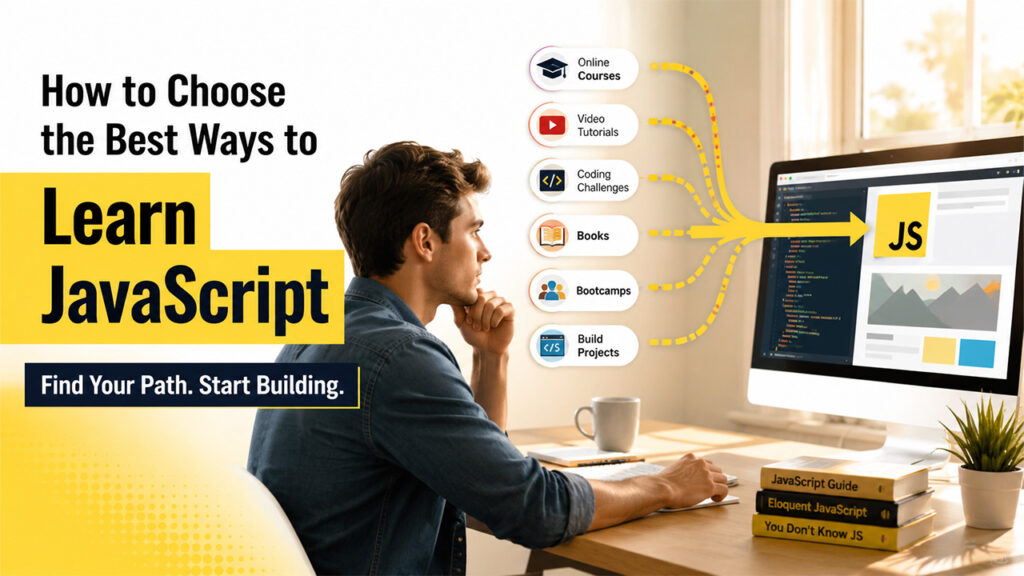
With seven solid options on the table, picking where to start can feel harder than the coding itself. These questions should make the decision easier:
Choose a Learning Method That Fits Your Learning Style: A course or coding bootcamps will suit you more if you focus best with structure and deadlines. You might feel lost with a stack of loose YouTube videos. If you’re a self-learner and like figuring things out on your own, challenge platforms and books might work better for you.
If writing code isn't your goal at all, tools built around No Coleade platforms might suit you better than learning JavaScript from scratch.
Define Your JavaScript Learning Goals: Learning JavaScript as a hobby is a very different journey than learning it to switch careers in six months. Be honest about what you want to do after learning it and your timeline, because it changes which method makes sense first.
Consider Your Budget, Time, and Learning Commitment: If your budget is low, you can use free resources like YouTube and freeCodeCamp as they cost nothing. However, they ask for more of your time and self-discipline. Paid options like bootcamps cost more upfront but often move faster and offer support you won't get for free.
Check the Quality and Recency of Learning Resources: There are hundreds or thousands of courses available that claim to be the best. However, not every course or tutorial is worth your time. Before you begin, look at reviews, instructor experience, and whether the content has been updated recently as JavaScript and its tools change often.
Combine Different Ways to Learn JavaScript: The learners who don’t give up halfway usually pair a structured course with regular practice, whether that's coding challenges, a personal project, or both. Combining methods is what turns information into actual skill.
Conclusion
Learning JavaScript in 2026 is not finding a single perfect course and sticking with it. It's about combining a few of the best ways to learn JavaScript that fit your learning style and sticking with them long enough to build real skill.
If you don’t know where to start, begin with something structured to learn the basics, then get hands-on practice by solving problems, whether that’s coding challenges, personal projects, or a coding bootcamp if you want speed and support. The learners who succeed aren't necessarily the most naturally talented ones; they're the ones who kept building even when the code didn't work the first time. JavaScript rewards persistence more than perfection, and with the right combination of methods, you'll get there.
Frequently Asked Questions (FAQs)
How long does it take to learn JavaScript?
Most beginners grasp the basics in two to three months with consistent practice, though real fluency takes longer.
Do I need to know HTML and CSS first?
It helps but isn't required. Many learners pick up basic HTML and CSS alongside JavaScript.
Is JavaScript hard to learn for beginners?
No. It's considered one of the more beginner-friendly languages, especially with strong community support and free resources.
Can I get a job with just JavaScript?
Yes. Many front-end and full-stack roles hire based on strong JavaScript skills alone, especially with a solid portfolio.
What should I build first as a beginner?
Start small with a to-do list, calculator, or simple game. Small projects teach more than long tutorials.
%201.png)

%201.png)

%201.png)